August 04, 2015

#SUTS - Raymond Massey


TCM's Summer Under the Stars features a star a day every day in August. August 8 features the films of Raymond Massey beginning at 6 a.m. and ending at 6 a.m. the next morning. I'm pleased to be taking part in the 2015 TCM Summer Under the Stars Blogathon. Please check out Journeys in Classic Film and read some great articles by Kristen and also follow the links to other interesting material on the classic stars featured this month on TCM.

Raymond Massey by James Hill

Bio

Raymond Hart Massey (August 30, 1896 – July 29, 1983) was a Canadian/American actor. He was the scion of one of Canada's great pioneering industrial families and one of the most talented actors of his time. He was an absolute actor who, in his career, had played numerous roles, including Hamlet, Ethan Frome, Prospero, the father in East of Eden, Professor Higgins in George Bernard Shaw's Pygmalion and Jonathan Brewster in the film version of Arsenic and Old Lace. Other memorable film roles include the husband of Joan Crawford during her Oscar-nominated role in Possessed (1947) and the doomed publishing tycoon Gail Wynand in The Fountainhead (1949), opposite Gary Cooper. Massey also won high praise in a dramatic reading of Stephen Vincent Benet's John Brown's Body, with Judith Anderson and Tyrone Power.

The role which provided Massey the greatest exposure was as Dr. Leonard Gillespie, the senior staff physician in the television series Dr. Kildare, which appeared on NBC from 1961 to 1965. But the role with which he was most closely associated was as President Abraham Lincoln in Abe Lincoln in Illinois.

Massey was born in Toronto, Ontario, the son of Anna (née Vincent), who was American-born, and Chester Daniel Massey, the wealthy owner of the Massey-Harris Tractor Company. He attended secondary school briefly at Upper Canada College, before transferring to Appleby College in Oakville, Ontario, and taking several courses at University of Toronto, where he was an active member of the Kappa Alpha Society. He later graduated from Balliol College, Oxford.

Massey worked in the family farm implement factory for a short time before enlisting in the First World War. He served as a Lieutenant in that conflict. Massey rejoined the Canadian Army for World War II, though he was eventually released from service and returned to acting work. Following the war, Massey became an American citizen.

When he returned from overseas after World War I and announced his intention to renounce his $22.50-a-week job in the Massey enterprise in favor of England and the stage, his father prayed for him. His brother Vincent, who was to become Canada's first native-born Governor General, asked: "What name are you going to use?"

Massey's first role in London was in Shaw's St. Joan. From there, his career seemingly never faltered. His talent embraced stage, screen and television.

Massey was a man who was far removed from the saturnine, darkly villainous, occasionally benevolent roles he assumed as an actor. He was amiable, accommodating, a likable raconteur.

Massey reckoned he had delivered Lincoln's farewell speech on leaving for Washington nearly 700 times. In his elderly years, he was still able to recite it from memory without hesitation. In his remarkably resonant voice, he intoned, "I now leave, not knowing when or whether I shall return. I am called upon to assume the Presidency at a time when 11 of our sovereign states have announced their intention to secede from the union, and threats of war increase in intensity from day to day. It is a grave duty that I now face. In preparing for it, I have tried to enquire what great principle or ideal it is which has kept this union so long together, and I believe it was that sentiment in the Declaration of Independence which gave liberty to the people of this country..."

There were publications which expressed doubts editorially that the role of the Great Emancipator could be played by a Canadian. But Massey convinced them that he was Lincoln and his portrayal became definitive. "I still think of the character I played as Abe as a very friendly fellow." President Franklin Roosevelt, who sat at Massey's side when Abe Lincoln in Illinois was shown in Washington, had another impression. "And he wrote all those speeches himself," Massey heard the President mutter to himself.

Although he wrote two books about his career, When I Was Young and A Hundred Different Lives, he did not enliven them, as was the fashion in such books, with malicious gossip, scandal or sexual episodes.

Massey was married three times.

1. Margery Fremantle from 1921 to 1929 (divorce); they had one child, architect Geoffrey Massey.

2. Adrianne Allen from 1929 to 1939 (divorce); Allen was a London and Broadway stage actress. They had two children who followed him into acting: Daniel Massey (October 10, 1933 - March 25, 1998) and Anna Massey (August 11, 1937 - July 3, 2011).

3. Dorothy Whitney from 1939 until her death in 1982.

His high-profile estrangement and then divorce from Adrianne Allen was the inspiration for Ruth Gordon and Garson Kanin's script for the film Adam's Rib (1949), starring Katharine Hepburn and Spencer Tracy, and indeed Massey married the lawyer who represented him in court, Dorothy Whitney, while his then ex-wife, Allen, married the opposing lawyer, William Dwight Whitney.


Abe Lincoln in Illinois: A Play in Three Acts by Robert Emmet Sherwood (1938)

The play covers the life of President Abraham Lincoln from his childhood through his final speech in Illinois before he left for Washington. The play also covers his romance with Mary Todd and his debates with Stephen A. Douglas, and uses Lincoln's own words in some scenes. Sherwood received the Pulitzer Prize for Drama in 1939 for his work. Raymond Massey portrayed Lincoln; he repeated his role in the 1940 film version.

On Broadway

Plymouth Theatre, now known as The Gerald Schoenfeld Theatre, is a Broadway theatre located at 236 West 45th Street (George Abbott Way) in midtown-Manhattan and renamed in 2005 in honor of Gerald Schoenfeld.
Opening Date: October 15, 1938
Closing Date: December 1939
Total Performances: 472
Category: Play, Drama, Original, Broadway
Setting: In and about New Salem, Illinois, in the 1830s. In and about Springfield, Illinois, 1840s - 1861.
Produced by The Playwrights' Company (Maxwell Anderson; S.N. Behrman; Elmer Rice; Robert E. Sherwood; Sidney Howard)
Written by Robert E. Sherwood
Staged by Elmer Rice
Scenic Design by Jo Mielziner
Business Manager: Victor Samrock
Stage Manager: Elmer Brown
Assistant Stage Mgr: John Triggs
Press Representative: William Fields and Phil Stevenson
Casting: Jane Broder
Assistant to Mr. Rice: Paul C. Krebs

Cast
Raymond Massey ..... Abe Lincoln
Ora Alexander ..... Ensemble
Dorothy Allan ..... The Edwards' Maid
Frank Andrews  ..... Mentor Graham
Lloyd Barry ..... Tad Lincoln
Bette Benfield ..... Ensemble
Hubert Brown ..... Gobey
Everett Charlton ..... Bab, Cavalry Captain, Militia Captain
George Christie ..... Ben Mattling
David Clarke ..... Feargus, Donner
May Collins ..... Elizabeth Edwards
Glenn Coulter ..... Kavanaugh
Howard Da Silva ..... Jack Armstrong
Dearon Darnay  ..... Ensemble
Robert Fitzsimmons ..... Ensemble
Lillian Foster ..... Nancy Green
John Gerard ..... Barrick
Dorothy Greeley ..... Ensemble
Arthur Griffin ..... Judge Bowling Green
David Hewes ..... Ensemble
Alfred Jenkins ..... Ensemble
Walter Kapp ..... Ensemble
Muriel Kirkland ..... Mary Todd
Harry Levian ..... Trum Cogdal, Jed
Adele Longmire ..... Ann Rutledge
George Malcolm ..... Ensemble
Lewis Martin ..... Ninian Edwards
Kevin McCarthy ..... Jasp, Phil
Lex Parrish ..... Willie Lincoln
John Payne ..... Robert Lincoln
Albert Phillips ..... Stephen A. Douglas
Wendell K. Phillips ..... William Herndon
McKinley Reeves ..... Ensemble
Elizabeth Reller ..... Ensemble
Marion Rooney ..... Aggie Gale
Herbert Rudley ..... Seth Gale
Bert Schorr ..... Ensemble
Allen Shaw ..... Ensemble
Howard Sherman ..... Jimmy Gale
Lotte Stawisky ..... Ensemble
Anne Stevenson ..... Ensemble
Calvin Thomas ..... Joshua Speed
Thomas F. Tracey ..... Sturveson
John Triggs ..... Ogleby
Frank Tweddell ..... Crimmin
Iris Whitney ..... Judith, The Lincolns' Maid
Dolores Williams ..... Ensemble
Joseph Wiseman ..... Ensemble
Harrison Woodhull ..... Ensemble

The play was revived on Broadway with Sam Waterston as Lincoln, with direction by Gerald Gutierrez. The revival ran from November 29, 1993 to January 2, 1994 at the Vivian Beaumont Theater in Lincoln Center.

In addition to the 1940 film, there were five television adaptations - in 1945, 1950, 1951, 1957, and 1964. Massey repeated his stage role in the 1950 and 1951 adaptations. The 1964 production in the Hallmark Hall of Fame featured Jason Robards in the title role.


Abe Lincoln in Illinois - The Film

Abe Lincoln in Illinois is a 1940 RKO biographical film which tells the story of the life of Abraham Lincoln (Raymond Massey) from his departure from Kentucky until his election as President of the United States.

The movie was adapted by Grover Jones and Robert E. Sherwood from Sherwood's Pulitzer Prize-winning play. It was directed by John Cromwell, produced by Max Gordon, edited by George Hively, with music by Roy Webb and cinematography by James Wong Howe.

The film received Academy Award nominations for Best Actor in a Leading Role (Raymond Massey) and Best Cinematography, Black-and-White (James Wong Howe).

The film recorded a loss of $740,000, making it one of the biggest financial disasters in RKO's history. Its failure moved one Hollywood wise-guy to collar Max Gordon at a party and say, "I can't understand it, Max. Lincoln was so kind to everybody but you."

Latter-day critics have complained about Massey's stolidity in his signature role, but even the most stone-hearted viewer will be moved by such scenes as Lincoln riding through the ruins of what once was the village of Salem; Abe's heated election-eve quarrel with his spiteful wife Mary; and his climactic speech from the observation car of the train that will carry him to Washington...and immortality.

After his success playing Lincoln in the film and on Broadway, Raymond Massey began to assume the character in real life. He often appeared at social gatherings dressed in Lincoln-esque attire, assuming a Lincoln-like manner and speech. His friend, the playwright George S. Kaufman, observed, "Massey won't be satisfied until someone assassinates him."

Raymond Massey as Abraham Lincoln

Film Cast
Raymond Massey as Abraham Lincoln (Reprising his role from the original Broadway production).
Gene Lockhart as Stephen Douglas
Ruth Gordon as Mary Todd Lincoln (Her screen acting debut).
Mary Howard as Ann Rutledge
Minor Watson as Joshua Speed
Alan Baxter as Billy Herndon
Harvey Stephens as Ninian Edwards
Howard Da Silva as Jack Armstrong (Reprising his role from the original Broadway production).
Dorothy Tree as Elizabeth Edwards
Aldrich Bowker as Judge Bowling Green
Maurice Murphy as John McNeil
Louis Jean Heydt as Mentor Graham
Clem Bevans as Ben Mattling
Harlan Briggs as Denton Offut
Herbert Rudley as Seth Gale (Reprising his role from the original Broadway production).
Andy Clyde as Stage Driver
Roger Imhof as Mr. Crimmin
Edmund Elton as Mr. Rutledge
Leona Roberts as Mrs. Rutledge
Florence Roberts as Mrs. Bowling Green
George Rosener as Dr. Chandler
Trevor Bardette as John Hanks
Syd Saylor as John Johnston
Elisabeth Risdon as Sarah Lincoln
Charles Middleton as Tom Lincoln
Alec Craig as Trum Cogdall
John Cromwell as John Brown (uncredited)


Movie Trailer


Raymond Massey as Lincoln on the Radio

"Abraham Lincoln in the War Years" on Cavalcade of America: February 13, 1940 with Raymond Massey


"Abe Lincoln in Illinois" on The Ford Theater: February 8, 1948 with Raymond Massey


Raymond Massey as Lincoln on Television

Raymond Massey as Abraham Lincoln - November 20, 1949 - Chesterfield Supper Club

A segment from NBC's Chesterfield Supper Club starring Perry Como. Perry introduces a sketch with Raymond Massey as Abraham Lincoln and Denise Alexander as Perry's "daughter." Massey reads the Gettysburg Address.


Raymond Massey as Abraham Lincoln - February 10, 1960 - Kraft Music Hall

The final segment of Perry Como's Kraft Music Hall live broadcast on NBC. Raymond Massey as Abraham Lincoln is joined by the Ray Charles Singers with "The Battle Hymn of the Republic." The credits roll, but the show is running short! Perry and cast scramble to fill in two minutes. A rare look at live television.


TCM is showing 12 of Raymond Massey's films on August 8, 2015 as part of the Summer Under the Stars event. Abe Lincoln in Illinois, featured above, is on at 10:15 p.m. I'm not including it below.

6:00 AM - Things to Come (1936)


Things to Come is a 1936 British black-and-white science fiction film from United Artists, produced by Alexander Korda, directed by William Cameron Menzies, and written by H. G. Wells. The film stars Raymond Massey, Ralph Richardson, Cedric Hardwicke, Pearl Argyle, and Margaretta Scott.

8:00 AM - Drum, The (1938)
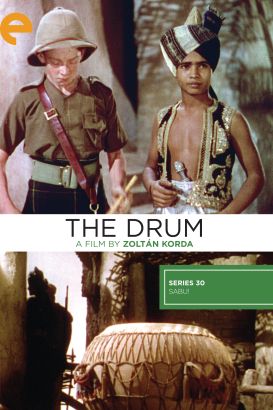

The Drum is a 1938 British Technicolor film from the book The Drum by A. E. W. Mason. The film was directed by Zoltan Korda and produced by Alexander Korda. It starred Sabu Dastagir, Raymond Massey, Roger Livesey, and Valerie Hobson.

9:45 AM - Scarlet Pimpernel, The (1935)


The Scarlet Pimpernel is a 1934 British adventure film directed by Harold Young and starring Leslie Howard, Merle Oberon, and Raymond Massey. Based on the classic adventure novel The Scarlet Pimpernel by Baroness Orczy, the film is about an eighteenth-century English aristocrat who leads a double life, appearing as an effete aristocrat while engaged in an underground effort to free French nobles from Robespierre's Reign of Terror. The film was produced by Alexander Korda.

11:30 AM - Santa Fe Trail (1940)


Santa Fe Trail is a 1940 American western film directed by Michael Curtiz and starring Errol Flynn, Olivia de Havilland, Raymond Massey and Ronald Reagan. Written by Robert Buckner, the film is about the abolitionist John Brown and his fanatical attacks on slavery as a prelude to the Civil War. Subthemes include J.E.B. Stuart and George Armstrong Custer as they duel for the hand of Kit Carson Holliday.

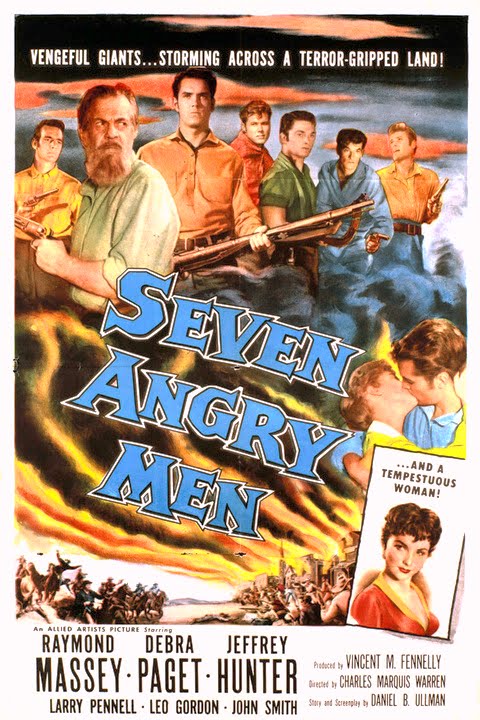
1:30 PM - Seven Angry Men (1955)


Seven Angry Men is a 1955 American western film directed by Charles Marquis Warren and starring Raymond Massey, Debra Paget and Jeffrey Hunter. Written by Daniel B. Ullman, the film is about the abolitionist John Brown's fanatical fight against slavery which ends with his 1859 arsenal raid at Harpers Ferry, (West) Virginia. The title refers to Brown and his six sons. Raymond Massey had previously played abolitionist John Brown in Santa Fe Trail (1940).

3:15 PM - Naked and The Dead, The (1958)


The Naked and the Dead is a 1958 widescreen film based on Norman Mailer's World War II novel The Naked and the Dead. It was filmed in Panama and stars Aldo Ray, Cliff Robertson and Raymond Massey. Filmed by RKO just before its demise, the film was released by Warner Brothers and was the last film Raoul Walsh directed for that studio.

5:45 PM - Arsenic and Old Lace (1944)
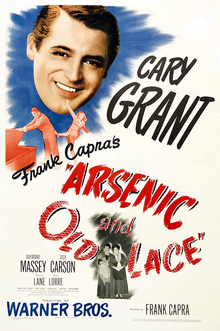

Arsenic and Old Lace is a 1944 American dark comedy film directed by Frank Capra, starring Cary Grant, and based on Joseph Kesselring's play Arsenic and Old Lace. The script adaptation was by Julius J. Epstein and Philip G. Epstein. Capra actually filmed the movie in 1941 because of star Cary Grant's availability, but it was not released until 1944, after the original stage version had finished its run on Broadway. Boris Karloff played Jonathan Brewster, who "looks like Karloff," on the Broadway stage, but he was unable to do the movie as well because he was still appearing in the play during filming, and Raymond Massey took his place. The film's supporting cast also features Priscilla Lane, Jack Carson, Edward Everett Horton and Peter Lorre.

8:00 PM - East of Eden (1955)


East of Eden is a 1955 film, directed by Elia Kazan, and loosely based on the second half of the 1952 novel of the same name by John Steinbeck. It is about a wayward young man who, while seeking his own identity, vies for the affection of his deeply religious father against his favored brother, thus retelling the story of Cain and Abel. The film stars Julie Harris, James Dean (in his first major screen role), and Raymond Massey. It also features Burl Ives, Richard Davalos and Jo Van Fleet.

12:15 AM - Desperate Journey (1942)


Desperate Journey is a 1942 American World War II action and aviation film starring Errol Flynn and Ronald Reagan, directed by Raoul Walsh. The supporting cast includes Raymond Massey, Alan Hale, Sr., and Arthur Kennedy. The melodramatic film featured a group of downed Allied airmen making their way out of the Third Reich, often with their fists.

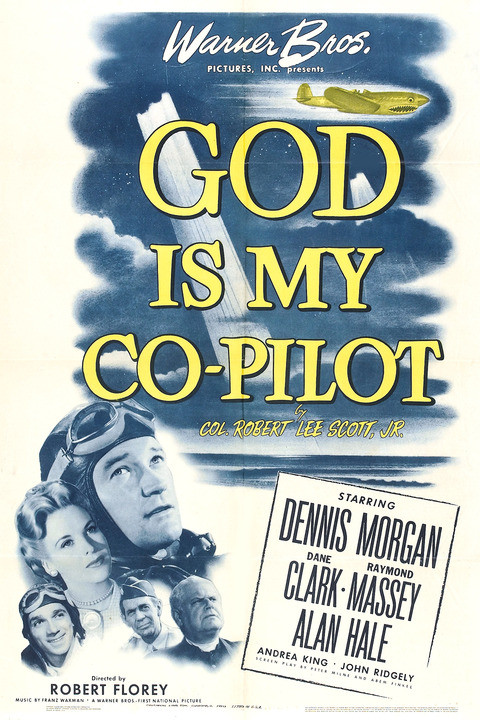
2:15 AM - God is My Co-Pilot (1945)


God is My Co-Pilot is a 1945 American black-and-white war film from Warner Brothers, produced by Robert Buckner, directed by Robert Florey, and starring Dennis Morgan, Raymond Massey and Dane Clark. The screenplay by Abem Finkel and Peter Milne is based on the autobiography of the same name by Robert Lee Scott, Jr. and tells the story of Scott's involvement with the Flying Tigers and the United States Army Air Forces in China and Burma during World War II.

4:00 AM - Chain Lightning (1950)


Chain Lightning is a 1950 American aviation film based on the story "These Many Years" by blacklisted writer Lester Cole (under the pseudonym J. Redmond Prior); the screenplay was written by Liam O'Brien and Vincent B. Evans. During World War II, Evans had been the bombardier on the Boeing B-17 Flying Fortress Memphis Belle. The film stars Humphrey Bogart as a test pilot, Eleanor Parker and Raymond Massey.

August 02, 2015

#SUTS - Adolphe Menjou


TCM's Summer Under the Stars features a star a day every day in August. August 3 features the films of Adolphe Menjou beginning at 6 a.m. and ending at 6 a.m. the next morning. I'm pleased to be taking part in the 2015 TCM Summer Under the Stars Blogathon. Please check out Journeys in Classic Film and read some great articles by Kristen and also follow the links to other interesting material on the classic stars featured this month on TCM.


Adolphe Jean Menjou (pronounced MAHN-zhoo) was an American actor. He was nominated for an Academy Award for The Front Page in 1931. Fluent in six languages, Menjou was nearly unrecognizable without some type of formal wear, and he was named Best Dressed Man in America nine times. His 1948 autobiography was titled It Took Nine Tailors.

Menjou was born February 18, 1890 in Pittsburgh, Pennsylvania, to a French father, Albert Menjou, and an Irish mother from Galway, Nora (née Joyce). He was a distant cousin of James Joyce. He had a brother named Henri who was a year younger.

Instead of acquiescing to his father's demands and obtaining an engineering degree at Cornell University, he abruptly changed his major to liberal arts and began auditioning for college plays. Attracted to the vaudeville stage, he made his movie debut in 1916 in The Blue Envelope Mystery. During World War I, he served as a captain in the United States Army ambulance service.

After the war, he broke into the top ranks in such films as The Sheik (1921) and The Three Musketeers (1921).

He became a star after playing the lead role in Charlie Chaplin's A Woman of Paris (1923), which established his screen persona: a dapper, suave man of the world complete with trademark waxy black mustache. He went on to play this role in more than 100 films, at first as a leading man and later as a character actor.

Menjou was a staunch Republican. In 1944 he became a co-founder of the Motion Picture Alliance for the Preservation of American Ideals, a group formed to oppose communist influence in Hollywood. Other prominent members of the Alliance included Robert Arthur, Martin Berkeley, Ward Bond, Walter Brennan, Clarence Brown, Charles Coburn, Gary Cooper, Laraine Day, Cecil B. DeMille, Walt Disney, Irene Dunne, Victor Fleming, Clark Gable, Cedric Gibbons, Hedda Hopper, Leo McCarey, James Kevin McGuinness, George Murphy, Fred Niblo, Dick Powell, Ayn Rand, Ronald Reagan, Ginger Rogers, Morrie Ryskind, Norman Taurog, Robert Taylor, Barbara Stanwyck, King Vidor, John Wayne, Frank Wead and Sam Wood.

Menjou was a "friendly" witness in the 1947 hearings of the House Un-American Activities Committee. His cooperation with HUAC hurt his later reputation.

Adolphe Menjou hosted and narrated Your Favorite Story, a TV anthology series that aired from 1953 through 1955. It premiered in December 1954 with the title Your Favorite Playhouse.

This program was adapted from the radio show Favorite Story which ran from 1946 through 1949. Menjou also acted in several episodes. It featured episodes originally written by Leonard St. Clair, William Makepeace Thackeray, Mary Roberts Rinehart, and Frank R. Stockton.

His last film was 1960's Pollyanna. He played the rumpled recluse Mr. Pendergast. He died after a nine-month battle with hepatitis on October 29, 1963. He was survived by his wife Verree Teasdale and their adopted son Peter.


Interesting Facts

Trademarks: Waxy black mustache and impeccable taste in clothes.

Once boasted that his wardrobe included about 2,000 articles -- over 100 suits and 15 overcoats alone.

My mother got to meet Adolphe Menjou while he was on a war bond tour during World War II. She was doing war work at Union Switch and Signal in Pittsburgh, Pennsylvania and Mr. Menjou stopped there and met the ladies. She remembers him as witty and extremely well-dressed. She also said he had kind eyes.

Menjou was an avid and skilled golfer. Clark Gable was among his favorite partners on the links.

In the 1950 film Sunset Boulevard, Jack Webb (as Artie Green) upon seeing his friend in evening clothes, asks William Holden (as Joe Gillis) "Judas E. Priest, who did you borrow that from? Adolphe Menjou?" to which Joe replies, "Close, but no cigar."

In "Irresistible Andy", the fifth episode of the first season of The Andy Griffith Show, Sheriff Andy Taylor compliments Barney Fife upon seeing him wearing his signature Salt and Pepper suit for the first time and calls him "The Adolphe Menjou of Mayberry."

Quote: "The [Marlon Brando] school are grabbers, not lovers. If it wasn't that the script says they get the girl, they wouldn't."

Adolphe Menjou Films on TCM August 3, 2015


Sheik Ahmed Ben Hassan (Rudolph Valentino) takes Lady Diana Mayo (Agnes Ayers) to his camp when he finds the beauty in the desert. Although drawn to the Sheik, Lady Diana is able to resist his amorous advances. When his former French school chum Dr. Raoul de Saint Hubert (Adolphe Menjou) convinces him to let Diana go free, she is kidnapped by the villainous Omair (Walter Long), who promises her a fate worse than death. Menjou was a rising star at Paramount Pictures when this film was made.


The film, an atypical drama film for its creator, was written, directed, produced and later scored by Charlie Chaplin. It was the first major failure in Charles Chaplin's career. Many believe the film would have been a success if he taken his name off the picture altogether. It was Chaplin's first film as a partner in United Artists with Edna Purviance starring and himself only appearing in a cameo. Chaplin conceived this film to help Edna Purviance's career independent of him. However, while the film did boost Adolphe Menjou's career considerably, it did little for hers. The role of Pierre Revel made Menjou a true star.


The Easiest Way is a 1931 American Pre-Code MGM drama film directed by Jack Conway. Adapted from the 1909 play of the same name written by Eugene Walter and directed by David Belasco, the film stars Constance Bennett, Adolphe Menjou, Robert Montgomery, Clark Gable, and Anita Page. It was considered utterly scandalous in its day. An impoverished, beautiful young working-class girl quickly learns that she can get to Easy Street as a mattress back. Constance Bennett shacks up with rich older man Adolphe Menjou. You can guess how well that went over in 1931.


Men Call It Love is a 1931 American romance film directed by Edgar Selwyn and written by Doris Anderson. The screenplay was based on the play Among the Married by Vincent Lawrence. The film stars Adolphe Menjou, Leila Hyams, Norman Foster, Mary Duncan and Hedda Hopper. Director Edgar Selwyn, one of the people who actually founded the studio that would become MGM ("Goldwyn" was originally an amalgamation of his and his brother's name with co-owner Samuel Goldfish, who liked it so well he renamed himself after the studio). As usual, Adolph Menjou gives a fine performance as Tony Minot, a philanderer who only falls in love with married women.


The Great Lover is a 1931 film starring Adolphe Menjou and Irene Dunne, and directed by Harry Beaumont. The supporting cast includes Ernest Torrence and Baclanova. It was written by Leo Ditrichstein and based on the play written by Frederic Hatton. Adolphe Menjou is superb as the womanizing opera star who finally succumbs to Cupid's arrow. His portrayal is full of ribald humor and sensitivity. Irene Dunne is also excellent as the naive young ingenue.


The Milky Way is a 1936 comedy film starring Harold Lloyd. Directed by comedy veteran Leo McCarey, the film was written by Grover Jones, Frank Butler and Richard Connell based on a play of the same name by Lynn Root and Harry Clork. An example of the popular screwball comedy genre of the time, and critically Harold Lloyd's most successful talkie, it tells the story of a Brooklyn milkman who becomes middleweight boxing champion. The Milky Way features supporting performances by real life husband and wife Adolphe Menjou and Verree Teasdale. Adolphe Menjou's Gabby Sloan is a manic whirlwind of neurotic tics and apoplexy-in-the-making.


Turnabout is a 1940 comedy film directed by Hal Roach and starring Adolphe Menjou, Carole Landis and John Hubbard. Based on the 1931 novel of the same name by Thorne Smith (of Topper fame), the screenplay was written by Mickell Novack, Bernie Giler and John McClain with additional dialogue by Rian James. The movie is a harmless, offbeat romp for the cast, led by Adolphe Menjou, whose scene stealing is almost matched by Menjou's real-life wife Verree Teasdale.


Broadway Gondolier is a musical film directed by Lloyd Bacon. The film was released by Warner Brothers, and featured Dick Powell, Joan Blondell and Adolphe Menjou. Menjou plays Professor Eduardo de Vinci, Dick Powell's voice teacher and friend. Menjou's performance is enjoyable, especially when he tries to fool radio executive Grant Mitchell and sponsor Louise Fazenda, owner of Flagenheimer's Odorless Cheese, and tries to sing like Dick Powell.


A Star is Born is a 1937 American Technicolor romantic drama film produced by David O. Selznick and directed by William A. Wellman, with a script by Wellman, Robert Carson, Dorothy Parker and Alan Campbell. It stars Janet Gaynor as an aspiring Hollywood actress, and Fredric March as an aging movie star who helps launch her career. Other members of the cast include Adolphe Menjou, May Robson, Andy Devine, Lionel Stander and Carole Landis. Adolphe Menjou (Oliver Niles) is the studio head who sees a winner in Janet Gaynor (Esther Blodgett) and renames her Vicki Lester. A Star is Born is one of the screen's most enduring tales of tragic love. An honorary Oscar selected by a panel of cinematographers went to Howard Greene's Technicolor work, helping to change Academy rules two years later to recognize color cinematography as a separate category from Black and White. The film won an Academy Award for Best Writing (Original Story): William Wellman and Robert Carson. It was the first color film to be nominated for Best Picture. Some film historians believe that the marriage of Barbara Stanwyck and Frank Fay was the film's real-life inspiration. John Bowers has also been identified as inspiration for the Norman Maine character and the dramatic suicide-by-drowning scene near the end of the film (Bowers drowned in November 1936). The film entered the public domain in 1965 due to Warner Brother's failure to renew its copyright registration in the 28th year after publication. A Star is Born has already been remade twice, in 1954 with Judy Garland and James Mason, and in 1976 with Barbra Streisand and Kris Kristofferson.


Father Takes a Wife is a 1941 American comedy film starring Gloria Swanson and Adolphe Menjou. It was directed by Jack Hively and written by Herbert and Dorothy Fields. Menjou stars as a shipping magnate who has fallen for stage star Swanson; all business for decades, he is now in his second youth with this new romance. Menjou is in fine form in this fluffy "B" RKO comedy. Menjou called parts like this one "dress suit roles" in his autobiography.


Gold Diggers of 1935 is a Warner Brothers musical film directed and choreographed by Busby Berkeley and starring Dick Powell, Adolphe Menjou, Gloria Stuart and Alice Brady, and featuring Winifred Shaw, Hugh Herbert and Frank McHugh. The film is best known for the famous "Lullaby of Broadway" production number, which features Shaw singing the song which won Harry Warren (music) and Al Dubin (lyrics) an Academy Award. Hilarious Adolphe Menjou steals his every scene as Nicolai Nicoleff, the penniless Russian impresario.


Stage Door is a 1937 RKO film, adapted from the play of the same name by Edna Ferber and George S. Kaufman, that tells the story of several would-be actresses who live together in a boarding house at 158 West 58th Street in New York City. The film stars Katharine Hepburn, Ginger Rogers, Adolphe Menjou, Gail Patrick, Constance Collier, Andrea Leeds, Samuel S. Hinds, Lucille Ball, Eve Arden, and Ann Miller. Hepburn's famous lines during the play within the film, "The calla lilies are in bloom again. Such a strange flower, suitable to any occasion. I carried them on my wedding day and now I place them here in memory of something that has died," are from The Lake (1934), the play for which Dorothy Parker panned Hepburn's performance as "running the gamut of emotions from A to B." Adolphe Menjou was an ideal choice to play the genial cad making casual lecherous advances and deceitful promises.


The Hucksters is a 1947 MGM film directed by Jack Conway and starring Clark Gable that marked Deborah Kerr's American film debut. The supporting cast includes Sydney Greenstreet, Adolphe Menjou, Keenan Wynn, Edward Arnold and Ava Gardner. The movie is based on the novel of the same name by Frederic Wakeman, Sr. Bosley Crowther praised Adolphe Menjou, calling his contribution to the film "entertaining and fascinating." Craig Butler says, "Adolphe Menjou is practically perfect as an agency executive living in a pressure-filled world."


The Tall Target is a 1951 MGM crime film starring Dick Powell as New York Police Sergeant John Kennedy who tries to stop the assassination of Abraham Lincoln. It was directed by Anthony Mann and was written by George Worthing Yates (story and screenplay), Daniel Mainwaring (story, as Geoffrey Homes) and Art Cohn (screenplay). It also stars Paula Raymond, Adolphe Menjou, Marshall Thompson, Ruby Dee, Richard Rober, Leif Erickson, Will Geer, and Florence Bates. It is based on the Baltimore Plot, an alleged conspiracy in late February 1861 to assassinate President-elect Abraham Lincoln en route to his inauguration. Allan Pinkerton, founder of the Pinkerton National Detective Agency, played a key role by managing Lincoln's security throughout the journey. Though scholars debate whether or not the threat was real, clearly Lincoln and his advisors believed that there was a threat and took actions to ensure his safe passage through Baltimore, Maryland. Adolphe Menjou is outstanding and quite believable as the corrupt Colonel Caleb Jeffers.


New Moon is a 1930 black and white American musical filmization of the operetta The New Moon with music by Sigmund Romberg and book and lyrics by Oscar Hammerstein II and others. The original stage version premiered on Broadway in 1928. The 1930 film, directed by Jack Conway, starred Lawrence Tibbett, Grace Moore, Adolphe Menjou, Roland Young, Gus Shy, and Emily Fitzroy. It had an entirely different plot to the original play and is set in Russia. A 1940 film of the same name, also based on the operetta directed by Robert Z. Leonard and W. S. Van Dyke (uncredited), starred Jeanette MacDonald and Nelson Eddy. Adolphe Menjou is a fine presence as Governor Boris Brusiloff.

Adolphe Menjou in The Front Page (1931)


The Front Page is a 1931 American Pre-Code comedy film, directed by Lewis Milestone and starring Adolphe Menjou and Pat O'Brien. Based on a Broadway play of the same name written by Ben Hecht and Charles MacArthur, the film was produced by Howard Hughes, written by Bartlett Cormack and Charles Lederer, and distributed by United Artists. The supporting cast includes Mary Brian, George E. Stone, Matt Moore, and Edward Everett Horton. At the 4th Academy Awards, the film was nominated for Best Picture, Milestone for Best Director, and Menjou for Best Actor.

No one ever wrote better dialogue than Ben Hecht and Charles MacArthur. This film shows them at the top of their form. Lewis Milestone uses clever and creative camera angles and transitions to distract from the fact that this was originally written for the stage. The cast is delightful——especially Adolphe Menjou and Edward Everett Horton. The pacing is lively, driven by the crisp and cynical interplay of the reporters. The film is only slightly dated——most notably in the occasional cruel ethnic slurs by the reporters. A definite must-see. Watch the film below.


Adolphe Menjou on the Radio

"The Front Page" on Academy Award: June 22, 1946 with Pat O'Brien and Adolphe Menjou


"Conversation Piece" on Lux Radio Theatre: November 16, 1936 with Lily Pons, Adolphe Menjou, Marjorie Gateson, and George Sanders


"The Last of Mrs. Cheyney" on Lux Radio Theatre: May 11, 1942 with Norma Shearer, Walter Pidgeon, and Adolphe Menjou


"Morning Glory" on Lux Radio Theatre: October 12, 1942 with Judy Garland, John Payne, and Adolph Menjou


"A Star is Born" on The Screen Guild Theater: November 17, 1940 with Loretta Young, Adolphe Menjou, and Burgess Meredith