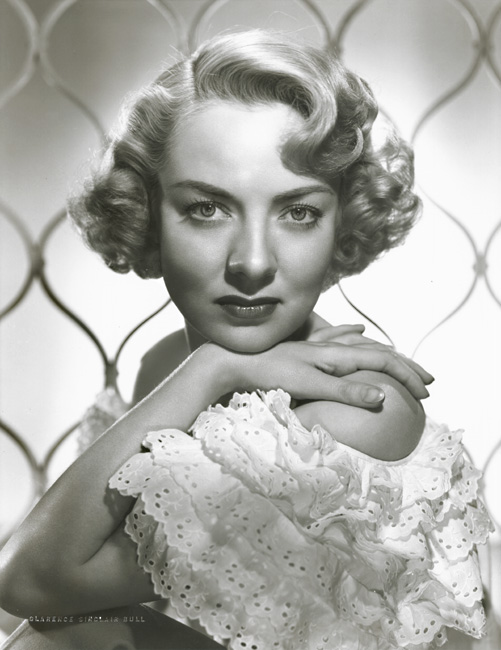
Juanita Moore, who earned an Academy Award nomination in 1960 for the single major film role she ever landed, then fell through the cracks of a Hollywood system with little to offer a black actress besides small parts as maids and nannies, died on Tuesday in Los Angeles. She was 99.
Her death was confirmed by her grandson, Kirk Kelleykahn, an actor and dancer.
Ms. Moore received a best supporting actress nomination for her role in the 1959 film Imitation of Life
 , in which she played opposite Lana Turner in a story about two single mothers, one black and one white. It was only the fifth time an African-American performer had been nominated for an Oscar.
The two women begin ostensibly as social equals living under the same roof, but their lives diverge along racial and class lines. Ms. Turner's character becomes a famous actress; Annie Johnson, played by Ms. Moore, becomes her housemaid.
The last film that the filmmaker Douglas Sirk directed in Hollywood, Imitation of Life
was widely dismissed as campy melodrama at the time. Its treatment of the intense suffering caused by racial bias, including a subplot in which Annie's light-skinned daughter renounces her to live as a white person, was seen as unbelievable. ("If by accident we should pass in the street," the daughter, played by Susan Kohner, tells her, "please don't recognize me." Ms. Kohner was also nominated for a best supporting actress Oscar.)But the film has since been re-evaluated and given high marks by many film historians and critics for the subtlety of its social criticism and psychological insight.
Ms. Moore's performance, in particular, has earned her generations of new fans, said Foster Hirsch, a professor of film at Brooklyn College who has organized several academic conferences on Imitation of Life.

"She delivers an astounding performance," Mr. Hirsch said. "She does a death scene that still reduces audiences to tears — I have seen it many times."
But after she was nominated for an Oscar, Ms. Moore told The Los Angeles Times in 1967, the work seemed to dry up. "The Oscar prestige was fine, but I worked more before I was nominated," she said. "Casting directors think an Oscar nominee is suddenly in another category. They couldn't possibly ask you to do one or two days' work."
It would be a decade more before black actresses like Ms. Moore would be considered for major roles, Mr. Hirsch noted.
Ms. Moore was born in Greenwood, Miss., on Oct. 19, 1914, and raised in South Central Los Angeles, the youngest of Harrison and Ella Moore's eight children. After graduating from high school and spending a few months at Los Angeles City College, she decamped for New York in search of a stage career.
She became a dancer. Throughout the 1930s and '40s she performed in the elaborate stage shows of nightclubs in Harlem, including the Cotton Club, and in Paris and London, before returning to Los Angeles. She studied acting at the Actors' Laboratory and began getting small, uncredited parts in films, like that of a maid and an African tribeswoman. She was already in her mid-30s by the times she made her film debut, in Elia Kazan's Pinky (1949), also a film about race. (Throughout her career she hid her true age, saying she had been born in 1922.)
After Imitation of Life
, she appeared in television dramas and in films including Walk on the Wild Side and The Singing Nun. She appeared on Broadway in James Baldwin's play The Amen Corner in 1965 and in a London production of A Raisin in the Sun. And she was active on the Los Angeles stage, performing with the Ebony Showcase Theater and the Cambridge Players.Mr. Kelleykahn, her grandson, is her only immediate survivor. Ms. Moore's first husband, the dancer Nyas Berry, died in 1951. Her second husband, Charles Burris, a Los Angeles bus driver, died in 2001.
Sam Staggs, author of the 2009 book Born to Be Hurt: The Untold Story of Imitation of Life, said in a phone interview on Friday that Ms. Moore's performance was the major reason for the film's box-office success (it was one of the most successful movies made to that point by Universal Studios).
People came in droves to watch in the dark and weep, Mr. Staggs said: "There are many, many people alive today who remember crying at her performance, but who could not tell you her name."