Ricardo Montalban dies at 88
LOS ANGELES – Ricardo Montalban, the Mexican-born actor who became a star in splashy MGM musicals and later as the wish-fulfilling Mr. Roarke in TV's "Fantasy Island," died Wednesday morning at his home, his family said. He was 88.
Montalban's death was first announced at a city council meeting by president Eric Garcetti, who represents the district where the actor lived. He died "from complications of advancing age," his son-in-law, Gilbert Smith, later said.
"He was so gracious, and Aaron was always humbled by Ricardo's gratitude for 'Fantasy Island," said Candy Spelling, wife of the late Aaron Spelling, who created the show. "I miss him already, and wish his family well."
Montalban had been a star in Mexican movies when MGM brought him to Hollywood in 1946. He was cast in the leading role opposite Esther Williams in "Fiesta," and starred again with the swimming beauty in "On an Island with You" and "Neptune's Daughter."
But Montalban was best known as the faintly mysterious, white-suited Mr. Roarke, who presided over a tropical island resort where visitors fulfilled their lifelong dreams — usually at the unexpected expense of a difficult life lesson. "I am Mr. Roarke, your host. Welcome to Fantasy Island," he told arriving guests.
Montalban had already coined a cultural catchphrase before the show, which ran from 1978 to 1984. As the celebrity spokesman for mid-1970s models of the Chrysler Cordoba, Montalban unwittingly opened himself up to endless imitation when he described the car's optional seats as being "available in soft, Corinthian leather."
More recently, he appeared as villains in two hits of the 1980s: "Star Trek: The Wrath of Khan" and — in line with his always-apparent sense of humor about himself — the farcical "The Naked Gun: From the Files of Police Squad."
Montalban's longtime friend and publicist David Brokaw said the actor was "exactly how you'd imagine him to be" off camera. "What you saw on the screen and on television and on talk shows, this very courtly, modest, dignified individual, that's exactly who he was," Brokaw said.
Raul Yzaguirre, longtime president of National Council of La Raza, called Montalban "a hero" and noted the actor's contributions to his community. Montalban helped found the ALMA Awards, which honor and encourage fair portrayals of Latinos in entertainment.
"He was just a marvelous human being and an inspiration to be around," Yzaguirre said. "I hope his spirit pervades more of Hollywood — the spirit of humility and excellence and giving back to the community and just plain decency."
Between movie and TV roles, Montalban was active in the theater. He starred on Broadway in the 1957 musical "Jamaica" opposite Lena Horne, picking up a Tony nomination for best actor in a musical.
Montalban also toured in Shaw's "Don Juan in Hell," playing Don Juan, a performance critic John Simon later recalled as "irresistible." In 1965 he appeared on tour in the Yul Brynner role in "The King and I."
"Fantasy Island" received high ratings for most of its run on ABC, and still appears in reruns. Mr. Roarke and his sidekick, Tattoo, played by the 3-foot, 11-inch Herve Villechaize, reached the state of TV icons. Villechaize died in 1993.
In a 1978 interview, Montalban analyzed the ethereal quality of his character: "Was he a magician? A hypnotist? Did he use hallucinogenic drugs? I finally came across a character that works for me. He has the essence of mystery, but I need a point of view so that my performance is consistent. I now play him 95 percent believable and 5 percent mystery. He doesn't have to behave mysteriously; only what he does is mysterious."
In 1970, Montalban organized fellow Latino actors into an organization called Nosotros ("We"), and he became the first president. Their aim: to improve the image of Spanish-speaking Americans on the screen; to assure that Latin-American actors were not discriminated against; to stimulate Latino actors to study their profession.
Montalban commented in a 1970 interview:
"The Spanish-speaking American boy sees Butch Cassidy and the Sundance Kid wipe out a regiment of Bolivian soldiers. He sees `The Wild Bunch' annihilate the Mexican army. It's only natural for him to say, `Gee, I wish I were an Anglo.'"
Montalban was no stranger to prejudice. He was born Nov. 25, 1920, in Mexico City, the son of parents who had emigrated from Spain. The boy was brought up to speak the Castilian Spanish of his forebears. To Mexican ears that sounded strange and effeminate, and young Ricardo was jeered by his schoolmates.
His mother also dressed him with old-country formality, and he wore lace collars and short pants "long after my legs had grown long and hairy," he wrote in his 1980 autobiography, "Reflections: A Life in Two Worlds."
"It is not easy to grow up in a country that has different customs from your own family's."
While driving through Texas with his brother, Montalban recalled seeing a sign on a diner: "No Dogs or Mexicans Allowed." In Los Angeles, where he attended Fairfax High School, he and a friend were refused entrance to a dance hall because they were Mexican.
Rather than seek a career in Hollywood, Montalban played summer stock in New York. He returned to Mexico City and played leading roles in movies from 1941 to 1945. That led to an MGM contract.
"Movies were never kind to me; I had to fight for every inch of film," he reflected in 1970. "Usually my best scenes would end up on the cutting-room floor."
Montalban had better luck after leaving MGM in 1953, though he was usually cast in ethnic roles. He appeared as a Japanese kabuki actor in "Sayonara" and an Indian in "Cheyenne Autumn." His other films included "Madame X," "The Singing Nun," "Sweet Charity," "Escape from the Planet of the Apes" and "Conquest of the Planet of the Apes."
Montalban was sometimes said to be the source of Billy Crystal's "you look MAHvelous" character on "Saturday Night Live," though the inspiration was really Argentinian-born actor Fernando Lamas.
In 1944, Montalban married Georgiana Young, actress and model and younger sister of actress Loretta Young. Both Roman Catholics, they remained one of Hollywood's most devoted couples. She died in 2007. They had four children: Laura, Mark, Anita and Victor.
Montalban suffered a spinal injury in a horse fall while making a 1951 Clark Gable Western, "Across the Wide Missouri," and thereafter walked with a limp he managed to mask during his performances.
Despite the constant pain that grew worse as the decades wore on, the actor was able to take a role in an Aaron Spelling TV series, "Heaven Help Us." Twice a month in 1994, he flew to San Antonio for two or three days of filming as an angel who watched over a young couple.
And when asked to play the grandfather in "Spy Kids 2" and "Spy Kids 3," Montalban told filmmaker Robert Rodriguez in his self-effacing way: "I'm old. I'm in a wheelchair. And I have a Mexican accent. Three strikes and you're out," recalled Joel Brokaw, another of the actor's spokesmen.
"But Robert Rodriguez idolized Ricardo, and came up to his home in the Hollywood Hills to convince him to do the role," Brokaw said. He did, and despite his obvious pain while waiting to do a scene, "something miraculous would happen," Brokaw said. "As soon as Rodriguez said 'Action,' his pain would completely disappear, time and time again. I asked him about this. He smiled and said, 'It's impossible for my mind to do two things at once.'"
Montalban is survived by daughters Laura and Anita, sons Victor and Mark and six grandchildren.
January 14, 2009


January 07, 2009
We've learned not to count out Yow
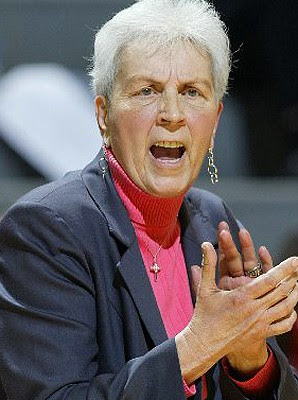
It was hard to watch North Carolina State coach Kay Yow walk off the court 21 months ago, after Connecticut ended her Wolfpack's unforgettable 2007 season in the Sweet 16 in Fresno. And it's difficult to hear the news today that Yow is stepping away from coaching for the rest of this season as she continues to fight the breast cancer that has been her on-again, off-again opponent for the last 22 years.
Although she had already missed four games this season because of flagging energy, the 66-year-old Yow made her decision with obvious reluctance.
"Stepping away from coaching is one of the hardest decisions I've had to make," said the Hall of Famer, who has spent the last 34 years of her 38-year head coaching career at NC State. "But I have great confidence in the experienced staff I have been working with for such a long time and the character of everyone involved in the program to respond positively to my decision."
Yow will be replaced on the bench on an interim basis by her long-time top assistant, Stephanie Glance.
It's premature to speculate on whether Yow will return to the bench again, but I, for one, would never count her out. Over the last few years I've learned you can't underestimate the passion and fight in this woman.
Two years ago Yow left her team for 16 games as she underwent aggressive chemotherapy. After she returned on Jan. 25, 2007, the Wolfpack won 12 of their next 14 games and "lifted my adrenaline so much that I didn't feel anything that was happening outside the court," said Yow.
The Pack's emotional run finally stopped with a 78-71 loss to Connecticut in the Sweet 16. As she walked off the court that March night wearing a brown wig on her head and bandages on her fingernails to hide some of the effects of chemotherapy, Yow gave the Wolfpack hand sign to a standing, cheering throng that included fans of LSU, Connecticut and Florida State. There wasn't a soul in the Save Mart Center who wasn't moved by Yow's courage, but many in attendance made the sad assumption that she had probably coached her last game.
I was one of them. I was in Fresno that weekend, and I know some of what Yow endured just to make that trip. An IV drip for the duration of the cross-country flight, daily blood tests, breathlessness, peeling fingernails, numbness in her feet, and skin pulling off with Band-Aids, just to name a few horrors. Basketball allowed Yow to forget, for a few hours every day, the brutal opponent she faces off the court. But I wondered how long she could split her energy between two all-consuming agendas-coaching her team and fighting her disease.
So I was one of the many who were surprised and delighted to see Yow return to the bench last season -- with more energy, a head of silvery hair, and a new treatment regime. She had two missions: to coach her team (the very young Wolfpack team would finish 21-13 and miss the NCAA tournament) and to lend her name to a national fight against breast cancer by launching the Kay Yow/WBCA Cancer Fund. Along the way, she got Connecticut coach Geno Auriemma and Tennessee coach Pat Summitt to put aside their differences long enough to join her a TV promo for the fund, which has raised over $600,000 for cancer research to date.
Some of Kay Yow's future is uncertain, but this part is not: whether or not she is able to make another comeback to the bench, she will continue to be an inspiration to her players, to legions of cancer patients, and to anyone who has been touched by her or her story.

It was hard to watch North Carolina State coach Kay Yow walk off the court 21 months ago, after Connecticut ended her Wolfpack's unforgettable 2007 season in the Sweet 16 in Fresno. And it's difficult to hear the news today that Yow is stepping away from coaching for the rest of this season as she continues to fight the breast cancer that has been her on-again, off-again opponent for the last 22 years.
Although she had already missed four games this season because of flagging energy, the 66-year-old Yow made her decision with obvious reluctance.
"Stepping away from coaching is one of the hardest decisions I've had to make," said the Hall of Famer, who has spent the last 34 years of her 38-year head coaching career at NC State. "But I have great confidence in the experienced staff I have been working with for such a long time and the character of everyone involved in the program to respond positively to my decision."
Yow will be replaced on the bench on an interim basis by her long-time top assistant, Stephanie Glance.
It's premature to speculate on whether Yow will return to the bench again, but I, for one, would never count her out. Over the last few years I've learned you can't underestimate the passion and fight in this woman.
Two years ago Yow left her team for 16 games as she underwent aggressive chemotherapy. After she returned on Jan. 25, 2007, the Wolfpack won 12 of their next 14 games and "lifted my adrenaline so much that I didn't feel anything that was happening outside the court," said Yow.
The Pack's emotional run finally stopped with a 78-71 loss to Connecticut in the Sweet 16. As she walked off the court that March night wearing a brown wig on her head and bandages on her fingernails to hide some of the effects of chemotherapy, Yow gave the Wolfpack hand sign to a standing, cheering throng that included fans of LSU, Connecticut and Florida State. There wasn't a soul in the Save Mart Center who wasn't moved by Yow's courage, but many in attendance made the sad assumption that she had probably coached her last game.
I was one of them. I was in Fresno that weekend, and I know some of what Yow endured just to make that trip. An IV drip for the duration of the cross-country flight, daily blood tests, breathlessness, peeling fingernails, numbness in her feet, and skin pulling off with Band-Aids, just to name a few horrors. Basketball allowed Yow to forget, for a few hours every day, the brutal opponent she faces off the court. But I wondered how long she could split her energy between two all-consuming agendas-coaching her team and fighting her disease.
So I was one of the many who were surprised and delighted to see Yow return to the bench last season -- with more energy, a head of silvery hair, and a new treatment regime. She had two missions: to coach her team (the very young Wolfpack team would finish 21-13 and miss the NCAA tournament) and to lend her name to a national fight against breast cancer by launching the Kay Yow/WBCA Cancer Fund. Along the way, she got Connecticut coach Geno Auriemma and Tennessee coach Pat Summitt to put aside their differences long enough to join her a TV promo for the fund, which has raised over $600,000 for cancer research to date.
Some of Kay Yow's future is uncertain, but this part is not: whether or not she is able to make another comeback to the bench, she will continue to be an inspiration to her players, to legions of cancer patients, and to anyone who has been touched by her or her story.
Subscribe to:
Posts (Atom)