July 17, 2015

#NoirSummer - TCM's Summer of Darkness July 24, 2015

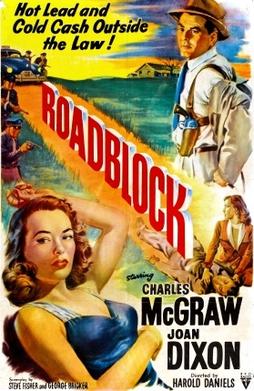
Roadblock (1951)


Leonard Maltin Review **1/2:
D: Harold Daniels. Charles McGraw, Joan Dixon, Lowell Gilmore, Louis Jean Heydt, Milburn Stone. Insurance investigator's growing attachment to a money-hungry woman leads him to crime. Typical film noir formula, smoothly executed.

Meredy's Thoughts:
This is a low-budget but highly engrossing film noir. In noir fashion sex and money leads to Joe Peters' (Charles McGraw's) destruction in the film. According to film critics Robert Porfiero and Alain Silver, the screenwriters take a hard-boiled mystery plot and combine it with "an aura of middle-class malaise and pervasive corruption to provide a motivation for Peters' alienation and fall." And, the noir notion of entrapment is illustrated by the staging of Peters' death in the semi-dry Los Angeles river bed, in one of the first car chases to be filmed there. I'm going to watch this one.

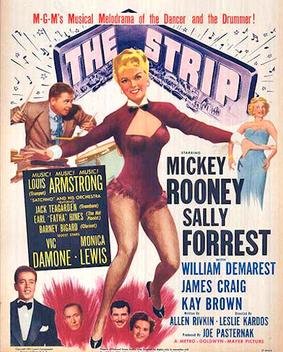
Strip, The (1951)

Leonard Maltin Review **:
D: László Kardos. Mickey Rooney, Sally Forrest, William Demarest, James Craig. Rooney gives sincere, energetic performance as former drummer involved with gangsters, trying to help Forrest get a movie break. Routine film enlivened by great music of Louis Armstrong, Earl Hines, Jack Teagarden and all-star group.

Meredy's Thoughts:
Much of the picture was shot on location in and around the Sunset Strip. Interiors were shot at popular nightclubs Mocambo and Ciro's and at restaurants Little Hungary and Stripps. Pete Rugolo, who is credited with Leo Arnaud with the film's orchestrations, was a well-known jazz arranger. The film effectively captures the existential mood and the glee derived from the club scene on the Strip. The song "A Kiss to Build a Dream On" was nominated for an Academy Award for Best Song. Definitely worth a look for the music alone.

Beware, My Lovely (1952)
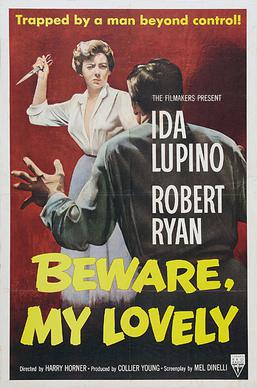

Leonard Maltin Review **1/2:
D: Harry Horner. Ida Lupino, Robert Ryan, Taylor Holmes, Whitehead, Barbara Whiting. Brooding, atmospheric psychological thriller with kindly World War I widow Lupino hiring wanderer Ryan as a handyman and discovering he's a psychopath.

Meredy's Thoughts:
This film is based on the 1950 Broadway play The Man by Mel Dinelli who also wrote the screenplay. Dorothy Gish and Don Hanmer played the leads on Broadway. The story was also featured on the CBS radio show Suspense as "To Find Help" on January 18, 1945 with Frank Sinatra as Howard and Agnes Moorehead as Mrs. Gillis (Mrs. Gordon in the film). It was dramatized again on Suspense on January 6, 1949 with Gene Kelly and Ethel Barrymore.
The movie was shot over an 18 day period in 1951 for Collier Young and Ida Lupino's production company, The Filmakers. Howard Hughes, then the head of RKO, withheld the film from release for a year. Co-star Robert Ryan later said that he felt Hughes tried to bury the film because Ryan was active in left-wing politics and spoke publicly about his involvement.
If Robert Ryan and Ida Lupino are in a film together, I'm watching it.

Clash by Night (1952)
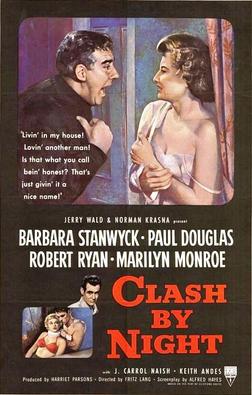


Leonard Maltin Review ***:
D: Fritz Lang. Barbara Stanwyck, Paul Douglas, Robert Ryan, Marilyn Monroe, Keith Andes, J. Carrol Naish. Moody, well-acted Clifford Odets story of drifter Stanwyck settling down, marrying good-natured fisherman Douglas. Cynical friend Ryan senses that she's not happy, tries to take advantage. Andes and Monroe provide secondary love interest.

Meredy's Thoughts:
Odets' Clash by Night was originally performed in 1941 as a neo-realist Broadway play with Tallulah Bankhead in the Stanwyck role. Fritz Lang changed the locale from Staten Island to a fishing town in California, but he kept intact the oppressive seacoast atmosphere.
The drama is structured into two almost equal parts and each is almost a complete drama in its own. The two parts are separated by a year in time. Each section begins with a non-fiction, documentary look at the fishing industry in Monterey, California. It then moves on to the story. Arguably, the motion picture is two films: each of around an hour's length and strung together as a serial.
The title of the film comes from Matthew Arnold's poem "Dover Beach" (1851). Specifically: It is a place "where ignorant armies clash by night."
The film features taut direction by Fritz Lang and a sizzling performance by Barbara Stanwyck. Example of her biting, caustic dialogue delivered with perfection. "What do you want, Joe, my life's history," she snaps. "Here it is in four words: big ideas, small results." Paul Douglas and Robert Ryan are fine. Marilyn Monroe is a pleasant, lighthearted addition in a supporting role.
Stanwyck, Ryan, Douglas and Monroe directed by Fritz Lang makes this film a must-see.

Kansas City Confidential (1952)
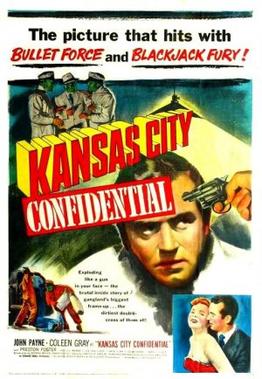

Leonard Maltin Review ***:
D: Phil Karlson. John Payne, Coleen Gray, Preston Foster, Neville Brand, Lee Van Cleef, Jack Elam, Dona Drake. Tough action drama with hard-luck ex-con Payne implicated in a bank heist, determined to quite literally unmask the real culprits. Quentin Tarantino must have seen this one prior to scripting Reservoir Dogs!

Meredy's Thoughts:
Phil Karlson’s filmmaking has few of the standard noir flourishes: the dark and brooding shadows, the bizarrely canted camera angles. Instead he works through gigantic close-ups and an unusually visceral treatment of bare-knuckle violence.
The cast is a good one. John Payne and Coleen Gray are particularly strong.
Though produced under the Hays Code censorship regulations, Kansas City Confidential constituted one of the most brutal and violent crime pictures made up through that time; as such, it retains historical significance. It also claims a strong cult following.
Add K.C.C. to your film noir queue. It has the best collection of baddies: Neville Brand, Lee Van Cleef and Jack Elam. In addition, Preston Foster isn't playing Roddy McDowall's daddy in this one.

Macao (1952)
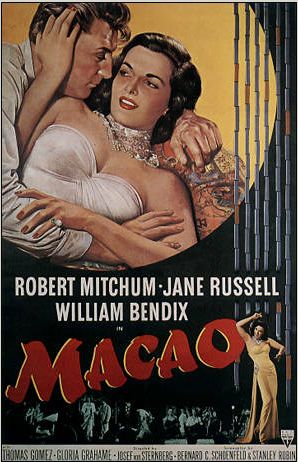

Leonard Maltin Review **:
D: Josef von Sternberg and Nicholas Ray. Robert Mitchum, Jane Russell, William Bendix, Gloria Grahame, Thomas Gomez, Brad Dexter, Philip Ahn. Flat yarn supposedly set in murky title port, with Russell a singer and Mitchum the action-seeking man she loves.

Meredy's Thoughts:
Producer Howard Hughes fired director von Sternberg during filming and hired Nicholas Ray to finish it. When many of Von Sternberg's scenes made no sense dramatically, Ray asked Robert Mitchum to write several bridging scenes. Filming was completed in 1950 but the film wasn't released until 1952.

Bruce Eder: "Jane Russell gives a sharp, naturalistic and purely sensual acting performance. She commands every scene in which she appears. Brad Dexter makes an excellent villain, like a more pathological version of Steve Cochran. Meanwhile, Robert Mitchum, in his portrayal of a neurotic, perhaps shell-shocked veteran, shows a vulnerable side that seldom came out so convincingly or touchingly in his RKO movies."

If you're looking for an underrated film noir gem, this is it!

Talk About a Stranger (1952)


Leonard Maltin Review ***:
D: David Bradley. George Murphy, Nancy Davis (Reagan), Billy Gray, Kurt Kasznar, Lewis Stone. A lonely boy tries to prove reclusive neighbor Kasznar killed his dog. Good use of California orchard locations, well-judged direction, and John Alton's moody photography result in a fine little B that deserves to be better known.

Meredy's Thoughts:
Based on Charlotte Armstrong's short story "The Enemy" with a screenplay by Margaret Fitts.
Bobby Fontaine (Billy Gray of Father Knows Best) is sure something malevolent is happening beneath the quiet surface of his small town. A good study in paranoia. Features wonderfully sinister cinematography by John Alton.

Split Second (1953)


Leonard Maltin Review **1/2:
D: Dick Powell. Stephen McNally, Alexis Smith, Jan Sterling, Keith Andes, Arthur Hunnicutt, Paul Kelly, Robert Paige, Richard Egan. Capable cast in odd suspenser about escaped convict (McNally) holding several people hostage in Nevada ghost town-- though well aware it's a nuclear test site! Script by William Bowers and Irving Wallace. Powell's directorial debut.

Meredy's Thoughts:
Dick Powell made an impressive directorial debut with this taut atomic-age noir. Novelist Irving Wallace collaborated on the script of Split Second with Chester Erskine and William Bowers. Features the top-notch black-and-white cinematography of Nick Musuraca. The cast does not disappoint. Alexis Smith is especially nasty. The ending is very memorable.
Not as well known as it should be. Give it a chance. My favorite noir dialogue: Larry Fleming (Keith Andes): You don't think very much of people, do you? Sam Hurley (Stephen McNally): I don't think very much of anything.

Narrow Margin, The (1952)


Leonard Maltin Review ***1/2:
D: Richard Fleischer. Charles McGraw, Marie Windsor, Jacqueline White, Queenie Leonard. Hard-boiled cop, transporting a gangster's widow against his will to the trial in which she'll testify, must dodge hit men aboard their train who are trying to silence her. One of the best B's ever made--fast paced, well acted, impressively shot in claustrophobic setting. Photographed by George E. Diskant; scripted by Earl Fenton, from a story by Martin Goldsmith and Jack Leonard. Remade in 1990. Also shown in computer-colored version.

Meredy's Thoughts:
Originally titled The Target, RKO's noir programmer The Narrow Margin is a hard-boiled masterpiece of gangland-flavored tough-guy dialogue and of economy in setting and pace. The screenplay by Earl Felton was nominated for an Academy Award.
Director Richard Fleischer, the son of famed cartoonist Max Fleischer, reached the high point of his low budget career with this film.
The Narrow Margin is considered by critics and film historians to be a classic example of film noir. Reflects the "noir view" of an unstable and deceiving moral reality. A must-see!

His Kind of Woman (1951)
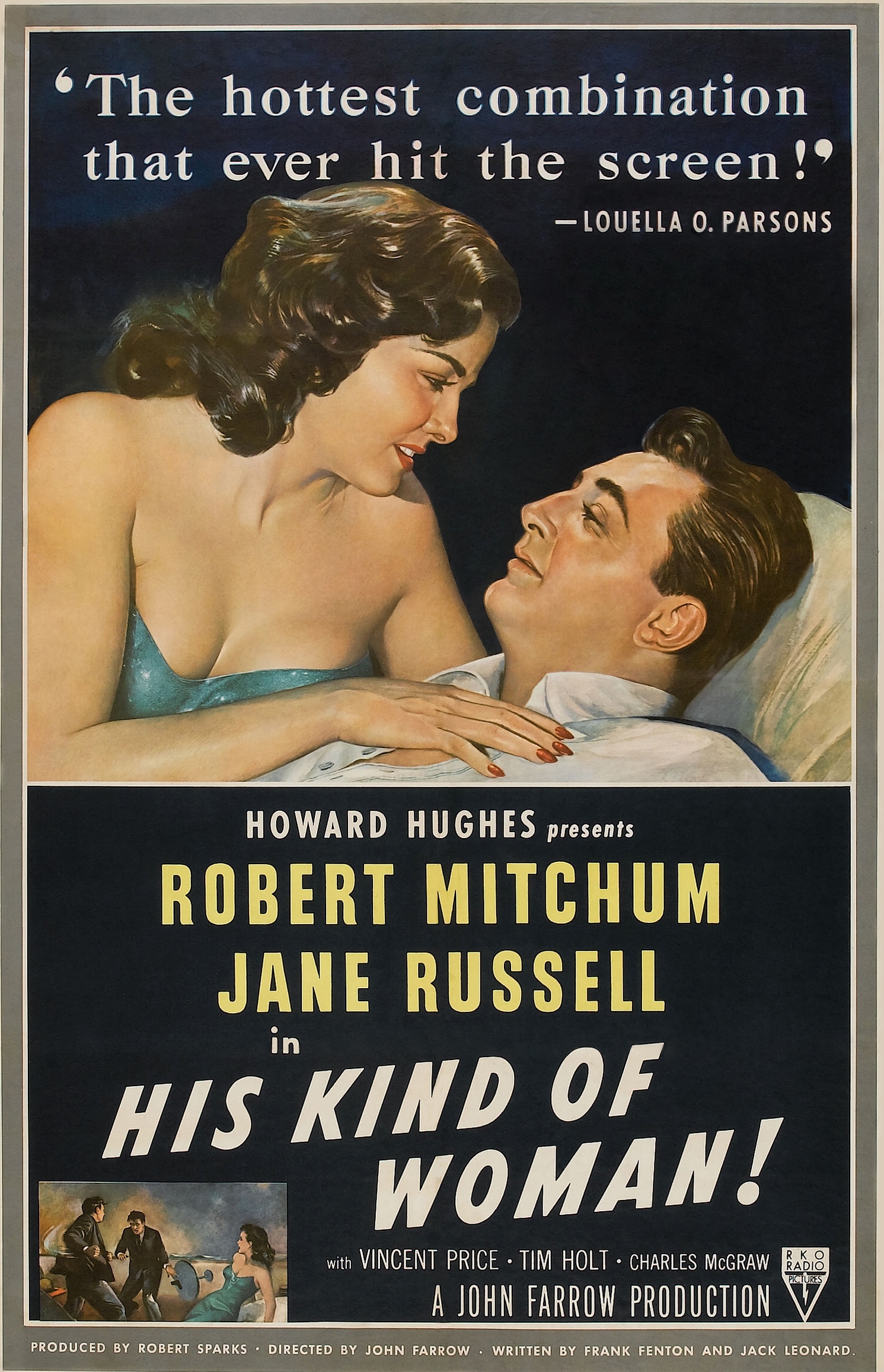

Leonard Maltin Review ***:
D: John Farrow and Richard Fleischer. Robert Mitchum, Jane Russell, Vincent Price, Tim Holt, Raymond Burr, Charles McGraw, Marjorie Reynolds, Jim Backus. Mitchum blindly goes to Mexico for a payoff of 50 grand, discovers he's the soon-to-be-dead chump whose identity will help deported gangster Burr re-enter the country. Cult film is overlong, but its spoofing of he-man heroics predates the more celebrated Beat the Devil by three years; Price is hilarious as a ham actor.

Meredy's Thoughts:
The movie was directed officially by John Farrow and based on the unpublished story Star Sapphie by Gerald Drayson. Howard Hughes was dissatisfied with John Farrow's work, and a number of scenes were cut, added, and re-shot by the uncredited Richard Fleischer.
Robert Mitchum is in his element as the loner anti-hero and Jane Russell is more than decent.
Technically, this film is a film noir crossed with a somewhat satirical comedy. The final third of the film is bizarre. Vincent Price's wild comic take is contrasted with a sadistic torture sequence involving Robert Mitchum.
It's a weird and wacky flick. Would make a good film for #TCMParty.

Locket, The (1946)


Leonard Maltin Review **:
D: John Brahm. Laraine Day, Brian Aherne, Robert Mitchum, Gene Raymond, Sharyn Moffet, Ricardo Cortez. Another of those post-WW2 psychological dramas, with Day as a woman who makes men fall in love with her--blinding them to her true personality (and problems). Famed for its flashback within a flashback within a flashback . . . but not very good. Look for young brunette Martha Hyer as a party guest and Ellen Corby as a household servant.

Meredy's Thoughts:
The film is based on a screenplay by Sheridan Gibney, adapted from "What Nancy Wanted" by Norma Barzman, wife of later-blacklisted writer Ben Barzman. Hume Cronyn originally bought the Norma Barzman screenplay to produce and direct the film with his wife Jessica Tandy in the lead role, but later sold the rights to RKO Pictures, which then assigned Gibney to rewrite the screenplay. The original Barzman screenplay is in the Cronyn-Tandy papers at the Library of Congress.
Wheeler Winston Dixon: "Director John Brahm keeps a firm hand on the proceedings, and effectively stages The Locket so that most of it happens at night, on claustrophobic studio sets. Mitchum, a rising star at the time, is oddly convincing as Norman Clyde, a Bohemian artist with attitude to spare, and Nicholas Musuraca’s moody lighting leaves the characters, and the viewer, in a state of continual confusion and suspense. Most intriguing, of course, is the triple-flashback structure of the film, which brings into question the reliability of the film’s narrative. When Dr. Blair bursts in on John Willis and begins his recital of Nancy’s crimes, Blair’s flashback contains Norman Clyde’s reminiscences, which in turn contain Nancy’s own memories of her childhood, as told to Norman, containing the incident of the locket."
A bit convoluted but intriguing. Getting the chance to watch Robert Mitchum effectively play a pussy-whipped artist is one reason to see this one.

Angel Face (1953)

Leonard Maltin Review **:
D: Otto Preminger. Robert Mitchum, Jean Simmons, Herbert Marshall, Mona Freeman, Leon Ames, Barbara O'Neil, Jim Backus. Ambulance driver Mitchum has the misfortune to meet, and become involved with, scheming young Simmons.

Meredy's Thoughts:
Angel Face is an intense Freudian melodrama by Otto Preminger. It's one of the forgotten masterworks of film noir. Jean Simmons and Robert Mitchum are terrific in their roles.
Film critic Paul Brenner wrote, "Preminger transforms a second rate James M. Cain murder plot, re-orchestrating this textbook tale of passion and murder into a haunting and haunted refrain. The by then clichéd story line is pared away and brought down to an elemental level -- there is not a wasted scene in the film — and the story's familiarity breeds an aftertaste of inevitability and doom. The hallucinogenic nature of the proceedings is accented with Preminger's direction and camerawork, having actors drift from foreground to background or having the camera track to fluid and suffocating close-ups. Preminger, ever the mesmerizer, weaves his style into a half-dreamt haze of nightmare."
This film is an atypical film noir that has developed a considerable cult reputation over the years. The cool, detached qualities that make Angel Face special will alienate many, but those who tune into it will be rewarded.

Elevator to the Gallows (1958)

Leonard Maltin Review **1/2:
D: Louis Malle. Jeanne Moreau, Maurice Ronet, Georges Poujouly, Yori Bertin, Jean Wall. A man and woman plan to murder her husband, but fall short of committing a "perfect crime.'' Intriguing, but doesn't hold up. This was Malle's first non-documentary feature as director. Music score improvised by Miles Davis. Also known as Lift to the Scaffold.

Meredy's Thoughts:
Ascenseur pour l'échafaud is a French crime film directed by Louis Malle. It was released as Elevator to the Gallows in the United States and as Lift to the Scaffold in the United Kingdom.
Tried to watch this one on Hulu Plus. Not my cup of tea.

July 13, 2015

#NoirSummer - TCM's Summer of Darkness July 17, 2015

Tension (1950)


Leonard Maltin Review **1/2:
D: John Berry. Richard Basehart, Audrey Totter, Cyd Charisse, Barry Sullivan, William Conrad, Tom D'Andrea, Lloyd Gough. Timid Basehart methodically plans to murder his wife's lover, only to have someone beat him to it in this intriguing melodrama.

Meredy's Thoughts:
Tension is a good example of noirish post-war disillusionment with a great cast. Richard Basehart plays a difficult leading role well. Audrey Totter is downright sinister and sadistic. Barry Sullivan and William Conrad are fine as police detectives. Andre Previn's score is meh with every cue practically telegraphed in advance. The MGM music department should have chosen Miklos Rozsa.

Where Danger Lives (1950)


Leonard Maltin Review **:
D: John Farrow. Robert Mitchum, Faith Domergue, Claude Rains, Maureen O'Sullivan. Dr. Mitchum finds himself deep in trouble when he falls hard for manipulative, desperate Domergue. Atmospheric, predictable, and forgettable potboiler.

Meredy's Thoughts:
This could have been a classic film noir if a better actress had played the deranged femme fatale. Jane Greer would have been perfect. Unfortunately, the casting of Howard Hughes' "discovery" Faith Domergue really hurts the picture. Domergue has the looks for the part but not the experience or talent. Claude Rains is magnificent in a small role. Robert Mitchum, cast against type, is also excellent. Other positives are a screenplay featuring some great explorations of noir themes and a journey into hell that is quite effective. John Farrow's direction is strong, especially in terms of impending doom that grows stronger as the film goes along.  Farrow nicely hits the nightmarish, hallucinatory qualities in this film noir plot. Nicholas Musuraca's cinematography is another great asset.

Woman on Pier 13, The (1950)
also known as I Married a Communist


Leonard Maltin Review **:
D: Robert Stevenson. Laraine Day, Robert Ryan, John Agar, Thomas Gomez, Janis Carter, Richard Rober, William Talman. Cornball acting and a "better-dead-than-Red'' scenario sink this noirish melodrama, which has become a relic of its era. Ryan is a shipping executive and former political radical whose past comes back to haunt him. The "commies'' (headed by Gomez) are depicted as two-bit gangsters, but Talman is especially good as a killer-for-hire.

Meredy's Thoughts:
This film previewed in Los Angeles and San Francisco in 1949 under the title I Married a Communist, but the name was changed prior to its 1950 release due to poor polling among those preview audiences. It was the first of RKO chief Howard Hughes' many anti-Red broadsides. Hughes offered the script to directors as a test of their patriotism. Thirteen directors turned down the film before it was finally made under the British director Robert Stevenson. The cast is an excellent one. Unfortunately, the actors are stuck with cartoon characters and an inane script. Communist villains are depicted in 1930's gangster flick fashion. A saving grace is the dramatic noir style photography by Micholas Musuraca.

Lady Without Passport, A (1950)


Leonard Maltin Review **1/2:
D: Joseph H. Lewis. Hedy Lamarr, John Hodiak, James Craig, George Macready. Turgid melodrama as Lamarr seeks to leave Havana, former romantic and business associations behind her.

Meredy's Thoughts:
A big problem I have with this film is the miscasting of Hedy Lamarr as a poor refugee from a concentration camp. She's too beautiful to be believable. In addition, she doesn't have the acting chops to pull off the role. The rest of the cast is uniformly good. Joseph H. Lewis' direction has flair and imagination and he makes the material work far better than it should. Though this is one of the much praised poverty row director's poorer films, it still is an interesting watch due to the strange effects of the visuals and the surreal atmospheric location shots.

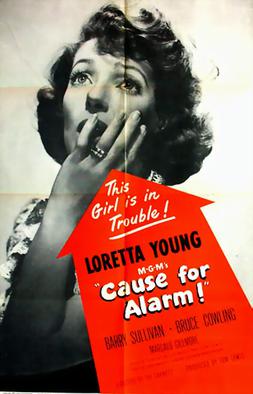
Cause for Alarm! (1951)


Leonard Maltin Review ***:
D: Tay Garnett. Loretta Young, Barry Sullivan, Bruce Cowling, Margalo Gillmore, Irving Bacon, Bradley Mora, Carl Switzer, Richard Anderson. Simple, effective thriller with Young registering as the panic-stricken wife of psychotic Sullivan. Tension builds, and there's a neat plot twist.

Meredy's Thoughts:
This unusual paranoiac film noir trades the dark alleys of urban menace for the sunny, tree-lined streets of middle-class suburbia. Loretta Young and Barry Sullivan are effective. Bruce Cowling is a tad wooden. Margalo Gillmore and Irving Bacon add a lot in support. (Irving Bacon plays a postman again! He was Blondie's postman.) Tay Garnett's smooth direction, Joseph Ruttenberg's cinematography and Andre Previn's score are also huge pluses. Young's deadened narration adds an eerie mood of doom to the suburban setting.

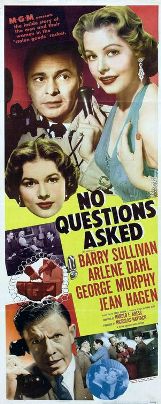
No Questions Asked (1951)


Leonard Maltin Review **1/2:
D: Harold F. Kress. Barry Sullivan, Arlene Dahl, Jean Hagen, George Murphy, William Reynolds, Mari Blanchard. Snappy little film of insurance company lawyer Sullivan seeking easy road to success via crime rackets.

Meredy's Thoughts:
No Questions Asked is a nicely done little "B" film noir. Sidney Sheldon's screenplay features a great opening, leading into a flashback that's good for a while then meanders a bit, followed by a solid climax. Barry Sullivan is good in the lead, Arlene Dahl is merely attractive and Jean Hagen steals the picture. No Questions Asked was in line with the harsher, less frothy fare produced by MGM during the Dore Schary regime.

Strangers on a Train (1951)


Leonard Maltin Review ****:
D: Alfred Hitchcock. Farley Granger, Ruth Roman, Robert Walker, Leo G. Carroll, Patricia Hitchcock, Marion Lorne. Walker gives his finest performance as psychopath involved with tennis star Granger in "exchange murders." Lorne is unforgettable as doting mother; so is merry-go-round climax. First-class Hitchcock, based on a Patricia Highsmith novel and coscripted by Raymond Chandler. Remade as Once You Kiss a Stranger and the inspiration for Throw Momma from the Train. British version of film, now available, runs almost two minutes longer, has a different ending and franker dialogue in the first scene where Granger and Walker meet.

Meredy's Thoughts and Some Trivia:
If you haven't seen Strangers on a Train, add it to your list. The film is number 32 on AFI's 100 Years... 100 Thrills. In this psychological crime thriller with film noir elements, Alfred Hitchcock explores one of his signature concerns: the coexistence of good and evil in one person. The story is structured through a series of doublings. Watch closely for the persistent pairs which point to the ineffable connection between Bruno and Guy. Doubles & contrasting doubles. Even a two-part melody in the opening segment with the shoes and walking. Doppelgängers.

Strangers on a Train was a novel before it was a movie. It was Patricia Highsmith's first novel and she included homosexual undertones in many of her works. Hitchcock and Robert Walker worked out an elaborate series of gestures and physical appearance to suggest the homosexuality and seductiveness of Bruno's character while bypassing censor objections.

Hitchcock and cinematographer Robert Burks collaborated on an ingenious double printing technique to create this iconic shot. To achieve the shot of Bruno murdering Miriam reflected in her glasses, an enormous distorting lens was constructed. The two actors were then reflected in it at a 90-degree angle.


The scene of the climactic fight on the carousel and the ride's subsequent explosion was very complicated to shoot with a combination of live action and rear screen projection. It usually took about a half day to set up each shot so the actors and the projected image matched.

The stunt where the man crawled under the carousel was not done with trick photography. Alfred Hitchcock claimed that this was the most dangerous stunt ever performed under his direction, and would never allow it to be done again.

Alfred Hitchcock's cameo appearance in this movie occurs 11 minutes into the film. He is seen carrying a double bass as he climbs onto the train.

Hitchcock personally designed Bruno's necktie with its threatening lobster claw image.

Hitchcock used the left side of the screen for evil and/or weaker characters. He used the right side of the screen for characters who are either good or temporarily dominant.

This is the movie that determined the location of Carol Burnett's star on the Hollywood Walk of Fame. In 1951, she was working as an usher when this film was playing at the Warner Theater on Hollywood Blvd. A couple arrived late, and Burnett, having already seen the film, advised them that it was a wonderful film that should be seen from the very beginning. The manager of the theater very rudely fired her for this. Years later, when Carol Burnett was asked where she would like to have her star placed on the Hollywood Walk of Fame, she requested that it be placed in front of that theater.

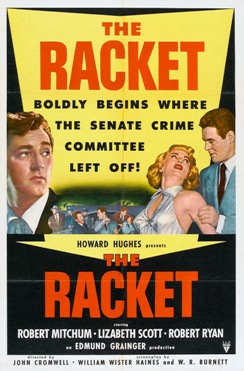
Racket, The (1951)


Leonard Maltin Review ***:
D: John Cromwell. Robert Mitchum, Robert Ryan, Lizabeth Scott, Ray Collins, William Talman, Robert Hutton, William Conrad, Don Porter. Police officer Mitchum and gangster Ryan spend almost as much time fighting their corrupt superiors as they do each other. Unusual film noir with strong performances (especially Ryan's) and bizarre ending; based on play previously filmed by producer Howard Hughes in 1928. Co-scripted by W.R. Burnett; some scenes were directed by Nicholas Ray.

Meredy's Thoughts:
The film, a remake of the 1928 film The Racket, is based on the Bartlett Cormack play. (Edward G. Robinson played the racketeer in the original Broadway production.) Both the silent and sound versions of the property were personally produced by Howard Hughes. Robert Mitchum and Robert Ryan turn in captivating performances. With Lizabeth Scott and William Talman along for the ride, it's worth a look.

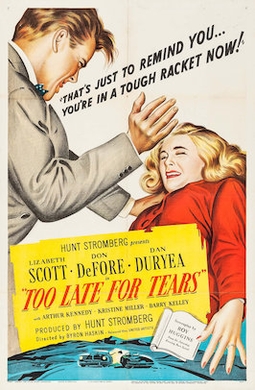
Too Late for Tears (1949)
also known as Killer Bait


Michael Phillips Review ***:
D: Byron Haskin. Lizabeth Scott, Don DeFore, Dan Duryea, Arthur Kennedy, Kristine Miller, Barry Kelley. The movie failed to find much of an audience in its own time. It looks a little better every year.
Synopsis: A married woman's discovery of stolen money changes her character for the worse.

Meredy's Thoughts:
The film was reissued as Killer Bait in 1955. The screenplay was written by Roy Huggins, developed from a serial he wrote for The Saturday Evening Post. It's proof positive that the love of money is the root of all evil. It relates to the ambitions the middle-class had during the postwar period to better their life materially and socially. Lizabeth Scott is fine as the femme fatale. The public domain prints are bad. Hoping for a great print from TCM. The film was restored in 2014 by the UCLA Film and Television Archive and the Film Noir Foundation, with the Hollywood Foreign Press Association providing some of the necessary funding.

Strange Love Of Martha Ivers, The (1946)


Leonard Maltin Review ***:
D: Lewis Milestone. Barbara Stanwyck, Kirk Douglas, Lizabeth Scott, Van Heflin, Judith Anderson, Darryl Hickman. Gripping melodrama, with Stanwyck bound to her husband by crime she committed long ago. Kirk Douglas' film debut.

Meredy's Thoughts:
The film is based on the short story "Love Lies Bleeding" by playwright John Patrick. In 1974, it fell into the public domain in the United States due to the copyright owner's failure to renew the copyright registration in the 28th year after publication. The film features compelling, multi-layered performances from the stars (including Lizabeth Scott). Humphrey Bogart and Lauren Bacall recommended Kirk Douglas to producer Hal B. Wallis. This one is a must-see.

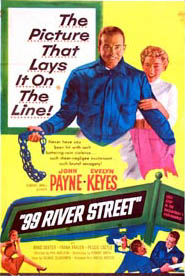
99 River Street (1953)


Leonard Maltin Review ***:
D: Phil Karlson. John Payne, Evelyn Keyes, Brad Dexter, Peggie Castle, Ian Wolfe, Frank Faylen. Rugged crime caper with Payne caught up in tawdry surroundings, trying to prove himself innocent of murder charge. Unpretentious film really packs a punch.

Meredy's Thoughts:
Director Phil Karlson made his mark in the 1950s with a series of tough, realistic, violent crime films noted for their gritty location shooting and Karlson's almost fanatic attention to detail. Karlson loves close-ups. They force the audience to concentrate on the character at hand, to experience his experience in a direct manner. Cinematographer Franz Planer provides some stunning, evocative shots and angles that compliment and enhance the action and the storytelling. Planer and Karlson handle the climactic sequence expertly. The cast is fine. Give this one a try. I think you'll enjoy it.

Conflict (1945)


Leonard Maltin Review **1/2:
D: Curtis Bernhardt. Humphrey Bogart, Alexis Smith, Sydney Greenstreet, Rose Hobart, Charles Drake, Grant Mitchell. Far-fetched story of husband (Bogart) plotting to murder wife (Hobart) to marry her sister (Smith). Unconvincing plot not salvaged by good cast.

Meredy's Thoughts:
Conflict should have been a classic film noir instead of an average one. Director Curtis Bernhardt leaves the plot with too many artificial devices to be effective. However, it is worth seeing just for the fact that the film is the only one in which Bogart and Greenstreet co-starred where Bogart, not Greenstreet, is the villain. This makes both portrayals a bit more complex than they would otherwise be.

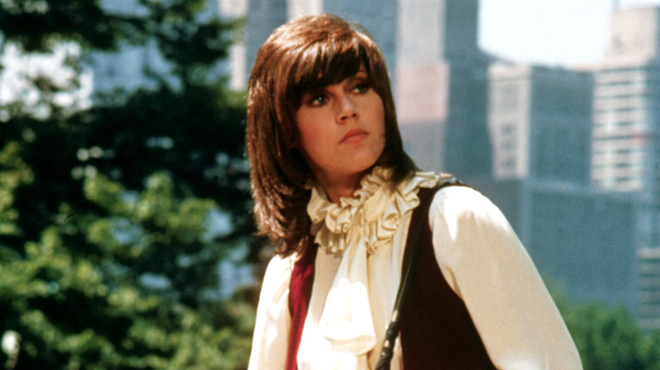
Klute (1971)


Roger Ebert Review ***1/2:
D: Alan J. Pakula. Jane Fonda, Donald Sutherland, Charles Cioffi, Roy Scheider, Dorothy Tristan, Rita Gam. Playing a complex, sharpy written part, Jane Fonda won the Best Actress Oscar for her strongest dramatic performance in Alan Pakula's well mounted dramatic thriller.
Synposis: A small-town detective searches for a missing man linked to a high-priced prostitute.

Meredy's Thoughts:
Klute is the first installment of what informally came to be known as Alan J. Pakula's "paranoia trilogy." The other two films in the trilogy are The Parallax View and All The President's Men. Fine neo-noir and worth seeing for the performances of Jane Fonda and Donald Sutherland alone.

Klute had Fonda showing off the shag hairstyle that became
so widespread that the shag is eponymous with the film’s title.