Meredy's blog about classic movies, classic stars, and Meredy.com updates.
January 23, 2010
"Guys and Dolls" actress Jean Simmons dies at 80
Jean Simmons, whose ethereal screen presence and starring roles with Hollywood's top actors made her a mid-century film icon, has died at age 80.
The actress, who sang with Marlon Brando in "Guys and Dolls;" costarred with Gregory Peck, Paul Newman and Kirk Douglas; and played Ophelia to Laurence Olivier's Hamlet, died Friday at her home in Santa Monica, her agent Judy Page told the Los Angeles Times. She had lung cancer.
Already a stunning beauty at 14, Simmons made her movie debut in the 1944 British production "Give Us the Moon."
Several minor films followed before British director David Lean gave the London-born actress her breakthrough role of Estella, companion to the reclusive Miss Havisham in 1946's "Great Expectations." That was followed by the exotic "Black Narcissus," and then Olivier's Oscar-winning "Hamlet" in 1948, for which Simmons was nominated as best supporting actress.
She would be nominated for another Oscar, for best actress for 1969's "The Happy Ending," before moving largely to television roles in the 1970s, '80s and '90s.
She won an Emmy Award for her role in the 1980s miniseries "The Thorn Birds."
Her other notable films included "Elmer Gantry" (with Burt Lancaster), "Until They Sail" (with Newman), "The Big Country" (Peck), "Spartacus," (Douglas), "This Earth Is Mine" (Rock Hudson), "All the Way Home" (Robert Preston), "Mister Buddwing" (James Garner) and "Rough Night in Jericho" (Dean Martin).
Simmons had left Britain for Hollywood in 1950, accompanied by her future husband Stewart Granger. There, they were befriended by reclusive tycoon Howard Hughes, who flew them to Tucson, Ariz., for a surprise wedding.
"When I returned from the honeymoon," Simmons told a reporter in 1964, "I learned that Hughes owned me — he had bought me from (British producer) J. Arthur Rank like a piece of meat."
What followed was a string of films that she would later dismiss as terrible, although she took some solace in the fact Hughes, legendary in those days as a womanizer, never bothered her.
"I was married to Jimmy (Granger's real name was James Stewart), so Hughes remained at a distance," she recalled. "But those movies! So terrible they aren't even on videocassettes."
Among the titles: "Angel Face," "Affair with a Stranger" and "She Couldn't Say No."
Simmons finally ended up suing Hughes for the right to make more prestigious films at other studios, and the result was "Young Bess" (as young Queen Elizabeth I), "The Robe" (the first movie filmed in CinemaScope), "The Actress," "The Egyptian" and "Desiree."
In the latter film, in 1954, she played the title role opposite Brando's Napoleon.
The pair teamed again in 1955 for "Guys and Dolls," the Samuel Goldwyn-produced musical in which Simmons is Sarah Brown, a Salvation Army-style reformer conned into a weekend fling in Havana by gambler Sky Masterson.
She loved the rehearsals for that film, Simmons recalled in 1988, "especially the dancing routines with Marlon trying not to step on me and choreographer Michael Kidd looking very worried."
"I got to sing," she added, "because Sam Goldwyn said, `You might as well wreck it with your own voice than somebody else's.'"
By the 1970s, her career as a lead film actress had ended, but Simmons continued to work regularly on stage and in television.
In the 1980s and '90s she appeared on such television shows as "Murder, She Wrote," "In the Heat of the Night" and "Xena: Warrior Princess." She also appeared in numerous TV movies and miniseries, including a 1991 version of "Great Expectations," in which she played Miss Havisham this time.
The careers of both Simmons and her husband Granger had flourished in the 1950s, he as a swashbuckler, she as the demure heroine. But long absences on film locations strained their relationship, and they divorced in 1960. They had a daughter, Tracy.
Shortly after her divorce, Simmons married Richard Brooks, who had directed her in "Elmer Gantry" and would again in "The Happy Ending." Their marriage, which produced a daughter, Kate. The couple separated in 1977 and later divorced.
December 17, 2009
Jennifer Jones Dies at 90
Jennifer Jones, who achieved Hollywood stardom in “The Song of Bernadette” and other films of the 1940s and ’50s while gaining almost as much attention for a tumultuous personal life, died Thursday at her home in Malibu, Calif. She was 90.
Ms. Jones, who was the chairwoman of the Norton Simon Museum in Pasadena, Calif., died of natural causes, said Leslie Denk, a museum spokeswoman. Ms. Jones was the widow of the industrialist and art patron Norton Simon.
After winning an Academy Award in 1944 for her performance in “The Song of Bernadette,” Ms. Jones went on to star in successful films like “Duel in the Sun” and “Love Is a Many-Splendored Thing.” She was nominated for Oscars five times.
She was also known for an off-screen life that included bouts of emotional instability; a second marriage to the Svengali-like David O. Selznick, the producer of “Gone With the Wind”; the suicide of their daughter; and a later marriage to another larger-than-life figure, Mr. Simon.
It was Selznick who got Ms. Jones the role of Bernadette Soubirous, the young French peasant girl whose visions at Lourdes created a sensation in 1858. “The Song of Bernadette,” based on Franz Werfel’s best-selling novel, was a huge hit, and it brought the little-known Ms. Jones instant fame.
“After that first big role, there was a kind of stage fright,” Ms. Jones said in 1981. She told another interviewer: “When you’re young, you’re full of hope and dreams. Later you begin to wonder. I did ‘The Song of Bernadette’ without knowing what was going on half the time.”
When she made “Bernadette,” Ms. Jones was the wife of the young actor Robert Walker and the mother of two small boys. She and her husband had met as students at the American Academy of Dramatic Arts in New York in 1938 and married a year later. They had struggled together until Selznick put Ms. Jones under personal contract in 1941. A year later, Mr. Walker was signed by MGM and had a star-making debut in 1943 as a young sailor in “Bataan.”
But the marriage didn’t last; they separated in the fall of 1943, and by then Ms. Jones was deeply involved with Selznick. Seventeen years her senior, he would be the mastermind of her career.
Selznick’s wife, Irene, the daughter of the movie mogul Louis B. Mayer, left him in 1945, in part over his affair with Ms. Jones, who divorced Mr. Walker that year. David Thomson, in his biography of Selznick, “Showman,” said Selznick had found something special in Ms. Jones. “She was so meek, so young, so lovely, so entirely ready to be David’s creation that she left all the responsibility with him,” Mr. Thomson wrote.
Ms. Jones and Selznick were married in 1949 on a yacht off the coast of Italy. Until his death in 1965, he made virtually all the decisions in his wife’s career. He supervised her dramatic training and produced many of her early movies, including “Since You Went Away” (1944), “Duel in the Sun” (1946), “Portrait of Jennie” (1948) and a lavish version, the second, of Ernest Hemingway’s “Farewell to Arms” (1957). The film, which also starred Rock Hudson, was a critical and box-office failure and the last movie Selznick made.
When Selznick lent his wife out to other producers, he often chose badly — turning down the classic film noir “Laura,” for example, or insisting that she star as the mentally ill Nicole Diver in the film version of F. Scott Fitzgerald’s “Tender Is the Night” when she was both too old for the role and in precarious mental health herself.
Ms. Jones never set her own course. Though her roles expanded — from the country girl Bernadette to the passionate half-caste young woman lusting after Gregory Peck in “Duel in the Sun” to the wealthy adulteress of Vittorio De Sica’s “Indiscretion of an American Wife” (1954) — the screen image was always as molded by Selznick.
But her acting was admired. She received Oscar nominations as best actress for her performances as an amnesiac cured by Joseph Cotten’s love in “Love Letters” (1945), as the wanton Pearl Chavez in “Duel in the Sun” and as a Eurasian doctor in love with a Korean War correspondent (William Holden) in “Love Is a Many-Splendored Thing” (1955).
Ms. Jones was born Phylis Lee Isley in Tulsa, Okla., on March 2, 1919, the only child of Philip and Flora Mae Isley. Her parents owned and starred in the Isley Stock Company, a tent-show theatrical troupe that toured the rural Midwest. As a child she spent her summers taking tickets, selling candy and acting in the company.
After a year at Northwestern University, she moved to the American Academy of Dramatic Arts, where she was cast as Elizabeth Barrett opposite Robert Walker’s Robert Browning in “The Barretts of Wimpole Street.” The two soon married, and on their honeymoon in 1939 they went to Hollywood, where they found bit roles.
Retreating to New York, the couple had a son, Robert Jr., in 1940, and another, Michael, less than a year later. Michael died in 2007. Robert survives her, as do eight grandchildren and four great-grandchildren.
Ms. Jones met Selznick in New York when she went to his office there to read for the lead in “Claudia,” Rose Franken’s hit stage play, which Selznick was turning into a movie. The title role went to Dorothy McGuire, who had starred in the play, but Selznick was taken by the lithe, dark-haired Ms. Jones and saw a future for her in Hollywood. (He came up with the name Jennifer Jones during that first encounter.)
Ambitious but emotionally fragile, Ms. Jones placed herself in Selznick’s hands. He cast her in a William Saroyan play, “Hello Out There,” in a theater season he was presenting in Santa Barbara, Calif., and she received rave reviews. He was already planning to lend her to his brother-in-law, the producer Bill Goetz, at 20th Century Fox, for “Song of Bernadette.”
After “Bernadette,” Selznick cast her as Claudette Colbert’s daughter in “Since You Went Away,” his bid to make a “Gone With the Wind” about the World War II home front. Ms. Jones was nominated for a supporting actress Oscar as the girl whose first love is a young soldier.
Though Ms. Jones and Mr. Walker were by then estranged, Selznick cast Mr. Walker as the soldier who is strengthened by Ms. Jones’s love. Mr. Walker, who later scored a success as the villain in Alfred Hitchcock’s “Strangers on a Train,” died at 32 in 1951 after years of emotional problems and drinking, which he attributed to his loss of Ms. Jones.
Among Ms. Jones’s other movies were the comedy “Cluny Brown” (1946), directed by Ernst Lubitsch; “Carrie” (1952), a film version of Theodore Dreiser’s novel “Sister Carrie” co-starring Laurence Olivier; John Huston’s “Beat the Devil” (1954) co-starring Humphrey Bogart; “Madame Bovary” (1949), co-starring James Mason; and “Ruby Gentry” (1952), a King Vidor film with Charlton Heston about destructive passions reminiscent of “Duel in the Sun.”
After Selznick’s death in 1965, Ms. Jones’s film career petered out in “The Idol” (1966), about a young man sleeping with the mother of his girlfriend; the low- budget “Angel, Angel, Down We Go” (1969); and the ensemble disaster movie “The Towering Inferno” (1974). In 1966 she made a rare stage appearance, in a revival of Clifford Odets’s “Country Girl” at New York City Center.
In 1967, Ms. Jones made headlines when she swallowed a bottle of sleeping pills and was discovered, near death, lying in the surf at Malibu. In 1976, Ms. Jones’s 21- year-old daughter, Mary Jennifer Selznick, jumped to her death from a building in West Los Angeles.
Ms. Jones married Norton Simon, in 1971, in a ceremony on a yacht in the English Channel after a courtship of three weeks. Mr. Simon, a multimillionaire industrialist who had turned a bankrupt orange juice bottling plant into a conglomerate that included Hunt Foods and Canada Dry, had retired in 1969 at 62 to concentrate on collecting art.
He spent more than $100 million on his collection, one of the country’s greatest private art collections, housed at the Norton Simon Museum.
After being stricken by the paralyzing neurological disorder Guillain-Barré syndrome, Mr. Simon resigned as president of the museum and was succeeded by Ms. Jones, who also took the title of chairwoman. She oversaw a gallery renovation by the architect Frank Gehry. Mr. Simon died in 1993 at age 86.
Throughout her life Ms. Jones appeared shy and aloof in public, and she rarely gave interviews. She explained why in one of the few she did give, in 1957.
“Most interviewers probe and pry into your personal life, and I just don’t like it,” she said. “I respect everyone’s right to privacy, and I feel mine should be respected, too.”
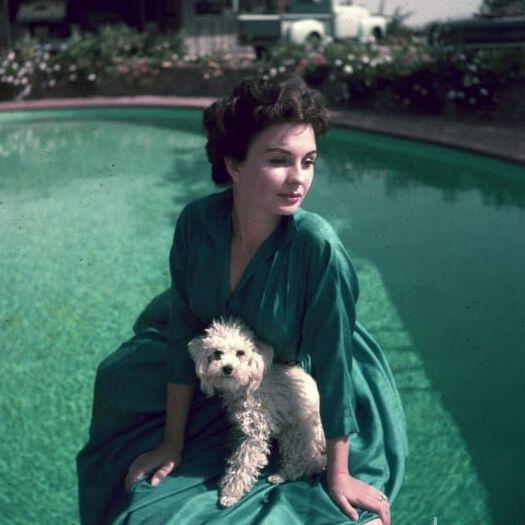
Ms. Jones, who was the chairwoman of the Norton Simon Museum in Pasadena, Calif., died of natural causes, said Leslie Denk, a museum spokeswoman. Ms. Jones was the widow of the industrialist and art patron Norton Simon.
After winning an Academy Award in 1944 for her performance in “The Song of Bernadette,” Ms. Jones went on to star in successful films like “Duel in the Sun” and “Love Is a Many-Splendored Thing.” She was nominated for Oscars five times.
She was also known for an off-screen life that included bouts of emotional instability; a second marriage to the Svengali-like David O. Selznick, the producer of “Gone With the Wind”; the suicide of their daughter; and a later marriage to another larger-than-life figure, Mr. Simon.
It was Selznick who got Ms. Jones the role of Bernadette Soubirous, the young French peasant girl whose visions at Lourdes created a sensation in 1858. “The Song of Bernadette,” based on Franz Werfel’s best-selling novel, was a huge hit, and it brought the little-known Ms. Jones instant fame.
“After that first big role, there was a kind of stage fright,” Ms. Jones said in 1981. She told another interviewer: “When you’re young, you’re full of hope and dreams. Later you begin to wonder. I did ‘The Song of Bernadette’ without knowing what was going on half the time.”
When she made “Bernadette,” Ms. Jones was the wife of the young actor Robert Walker and the mother of two small boys. She and her husband had met as students at the American Academy of Dramatic Arts in New York in 1938 and married a year later. They had struggled together until Selznick put Ms. Jones under personal contract in 1941. A year later, Mr. Walker was signed by MGM and had a star-making debut in 1943 as a young sailor in “Bataan.”
But the marriage didn’t last; they separated in the fall of 1943, and by then Ms. Jones was deeply involved with Selznick. Seventeen years her senior, he would be the mastermind of her career.
Selznick’s wife, Irene, the daughter of the movie mogul Louis B. Mayer, left him in 1945, in part over his affair with Ms. Jones, who divorced Mr. Walker that year. David Thomson, in his biography of Selznick, “Showman,” said Selznick had found something special in Ms. Jones. “She was so meek, so young, so lovely, so entirely ready to be David’s creation that she left all the responsibility with him,” Mr. Thomson wrote.
Ms. Jones and Selznick were married in 1949 on a yacht off the coast of Italy. Until his death in 1965, he made virtually all the decisions in his wife’s career. He supervised her dramatic training and produced many of her early movies, including “Since You Went Away” (1944), “Duel in the Sun” (1946), “Portrait of Jennie” (1948) and a lavish version, the second, of Ernest Hemingway’s “Farewell to Arms” (1957). The film, which also starred Rock Hudson, was a critical and box-office failure and the last movie Selznick made.
When Selznick lent his wife out to other producers, he often chose badly — turning down the classic film noir “Laura,” for example, or insisting that she star as the mentally ill Nicole Diver in the film version of F. Scott Fitzgerald’s “Tender Is the Night” when she was both too old for the role and in precarious mental health herself.
Ms. Jones never set her own course. Though her roles expanded — from the country girl Bernadette to the passionate half-caste young woman lusting after Gregory Peck in “Duel in the Sun” to the wealthy adulteress of Vittorio De Sica’s “Indiscretion of an American Wife” (1954) — the screen image was always as molded by Selznick.
But her acting was admired. She received Oscar nominations as best actress for her performances as an amnesiac cured by Joseph Cotten’s love in “Love Letters” (1945), as the wanton Pearl Chavez in “Duel in the Sun” and as a Eurasian doctor in love with a Korean War correspondent (William Holden) in “Love Is a Many-Splendored Thing” (1955).
Ms. Jones was born Phylis Lee Isley in Tulsa, Okla., on March 2, 1919, the only child of Philip and Flora Mae Isley. Her parents owned and starred in the Isley Stock Company, a tent-show theatrical troupe that toured the rural Midwest. As a child she spent her summers taking tickets, selling candy and acting in the company.
After a year at Northwestern University, she moved to the American Academy of Dramatic Arts, where she was cast as Elizabeth Barrett opposite Robert Walker’s Robert Browning in “The Barretts of Wimpole Street.” The two soon married, and on their honeymoon in 1939 they went to Hollywood, where they found bit roles.
Retreating to New York, the couple had a son, Robert Jr., in 1940, and another, Michael, less than a year later. Michael died in 2007. Robert survives her, as do eight grandchildren and four great-grandchildren.
Ms. Jones met Selznick in New York when she went to his office there to read for the lead in “Claudia,” Rose Franken’s hit stage play, which Selznick was turning into a movie. The title role went to Dorothy McGuire, who had starred in the play, but Selznick was taken by the lithe, dark-haired Ms. Jones and saw a future for her in Hollywood. (He came up with the name Jennifer Jones during that first encounter.)
Ambitious but emotionally fragile, Ms. Jones placed herself in Selznick’s hands. He cast her in a William Saroyan play, “Hello Out There,” in a theater season he was presenting in Santa Barbara, Calif., and she received rave reviews. He was already planning to lend her to his brother-in-law, the producer Bill Goetz, at 20th Century Fox, for “Song of Bernadette.”
After “Bernadette,” Selznick cast her as Claudette Colbert’s daughter in “Since You Went Away,” his bid to make a “Gone With the Wind” about the World War II home front. Ms. Jones was nominated for a supporting actress Oscar as the girl whose first love is a young soldier.
Though Ms. Jones and Mr. Walker were by then estranged, Selznick cast Mr. Walker as the soldier who is strengthened by Ms. Jones’s love. Mr. Walker, who later scored a success as the villain in Alfred Hitchcock’s “Strangers on a Train,” died at 32 in 1951 after years of emotional problems and drinking, which he attributed to his loss of Ms. Jones.
Among Ms. Jones’s other movies were the comedy “Cluny Brown” (1946), directed by Ernst Lubitsch; “Carrie” (1952), a film version of Theodore Dreiser’s novel “Sister Carrie” co-starring Laurence Olivier; John Huston’s “Beat the Devil” (1954) co-starring Humphrey Bogart; “Madame Bovary” (1949), co-starring James Mason; and “Ruby Gentry” (1952), a King Vidor film with Charlton Heston about destructive passions reminiscent of “Duel in the Sun.”
After Selznick’s death in 1965, Ms. Jones’s film career petered out in “The Idol” (1966), about a young man sleeping with the mother of his girlfriend; the low- budget “Angel, Angel, Down We Go” (1969); and the ensemble disaster movie “The Towering Inferno” (1974). In 1966 she made a rare stage appearance, in a revival of Clifford Odets’s “Country Girl” at New York City Center.
In 1967, Ms. Jones made headlines when she swallowed a bottle of sleeping pills and was discovered, near death, lying in the surf at Malibu. In 1976, Ms. Jones’s 21- year-old daughter, Mary Jennifer Selznick, jumped to her death from a building in West Los Angeles.
Ms. Jones married Norton Simon, in 1971, in a ceremony on a yacht in the English Channel after a courtship of three weeks. Mr. Simon, a multimillionaire industrialist who had turned a bankrupt orange juice bottling plant into a conglomerate that included Hunt Foods and Canada Dry, had retired in 1969 at 62 to concentrate on collecting art.
He spent more than $100 million on his collection, one of the country’s greatest private art collections, housed at the Norton Simon Museum.
After being stricken by the paralyzing neurological disorder Guillain-Barré syndrome, Mr. Simon resigned as president of the museum and was succeeded by Ms. Jones, who also took the title of chairwoman. She oversaw a gallery renovation by the architect Frank Gehry. Mr. Simon died in 1993 at age 86.
Throughout her life Ms. Jones appeared shy and aloof in public, and she rarely gave interviews. She explained why in one of the few she did give, in 1957.
“Most interviewers probe and pry into your personal life, and I just don’t like it,” she said. “I respect everyone’s right to privacy, and I feel mine should be respected, too.”
Subscribe to:
Posts (Atom)