Peter Graves, whose calm and intelligent demeanor was a good fit to the intrigue of "Mission: Impossible" as well as the satire of the "Airplane" films, has died.
Graves passed away Sunday just a few days before his 84th birthday outside his home in Los Angeles, publicist Sandy Brokaw said. Graves was returning from brunch with his wife of nearly 60 years and his family when he had what Graves' doctor believed was a heart attack, Brokaw said.
Graves first gained attention of many baby boomers with the 1950s TV series "Fury," but remained best known for the role of Jim Phelps, leader of a gang of special agents who battled evil conspirators in TV's "Mission: Impossible."
Normally cast as a hero, he turned in an unforgettable performance early in his career as the treacherous Nazi spy in Billy Wilder's 1953 prisoner-of-war drama "Stalag 17."
He also masterfully lampooned his straight-arrow image when he portrayed bumbling airline pilot Clarence Oveur in the 1980 disaster movie spoof "Airplane!"
Graves appeared in dozens of films and a handful of television shows in a career of nearly 60 years.
The authority and trust he projected made him a favorite for commercials late in his life, and he was often encouraged to go into politics.
"He had this statesmanlike quality," Brokaw said. "People were always encouraging him to run for office."
Graves was preceded in stardom by his older brother James Arness, who played Marshal Matt Dillon on TV's "Gunsmoke."
Born Peter Aurness, Graves adopted his grandfather's last name to avoid confusion with his older brother, who had dropped the "U" from the family name.
Graves' career began with cheaply made exploitation films like "It Conquered the World," in which he battled a carrot-shaped monster from Venus, and "Beginning of the End," in which he fought a giant grasshopper.
He later took on equally formidable human villains each week on "Mission: Impossible."
Every show began with Graves, as agent Phelps, listening to a tape of instructions outlining his team's latest mission and explaining that if he or any of his agents were killed or captured "the secretary will disavow any knowledge of your actions."
The tape always self-destructed within seconds of being played.
The show ran on CBS from 1966 to 1973, with Graves joining the cast in 1967, and was revived on ABC from 1988 to 1990 with Graves back as the only original cast member.
The actor credited clever writing for the show's success.
"It made you think a little bit and kept you on the edge of your seat because you never knew what was going to happen next," he once said.
He also played roles in such films as John Ford's "The Long Gray Line" and Charles Laughton's "The Night of the Hunter," as well as "The Court-Martial of Billy Mitchell," "Texas Across the River" and "The Ballad of Josie."
Graves' first television series was the children's Saturday morning show, "Fury," about an orphan and his untamed black stallion. It lasted six years on NBC.
In his later years, Graves brought his white-haired eminence to PBS as host of "Discover: The World of Science" and A&E's "Biography" series.
He noted during an interview in 2000 that he made his foray into comedy somewhat reluctantly.
Filmmakers Jim Abrahams and David and Jerry Zucker had written a satire on the airplane-in-trouble movies, and they wanted Graves and fellow handsome actors Lloyd Bridges, Leslie Nielsen and Robert Stack to spoof their serious images.
All agreed, but Graves admitted to nervousness. On the one hand, he said, he considered the role a challenge, "but it also scared me."
"I thought I could lose a whole long acting career," he recalled.
"Airplane!" became a box-office smash, and Graves returned for "Airplane II, The Sequel."
Graves was a champion hurdler in high school in Minnesota, as well as a clarinet player in dance bands and a radio announcer.
After two years in the Air Force, he enrolled at the University of Minnesota as a drama major and worked in summer stock before following his brother west to Hollywood.
He found enough success there to send for his college sweetheart, Joan Endress. They were married in 1950 and had three daughters - Kelly Jean, Claudia King and Amanda Lee - and six grandchildren.


January 23, 2010
"Guys and Dolls" actress Jean Simmons dies at 80
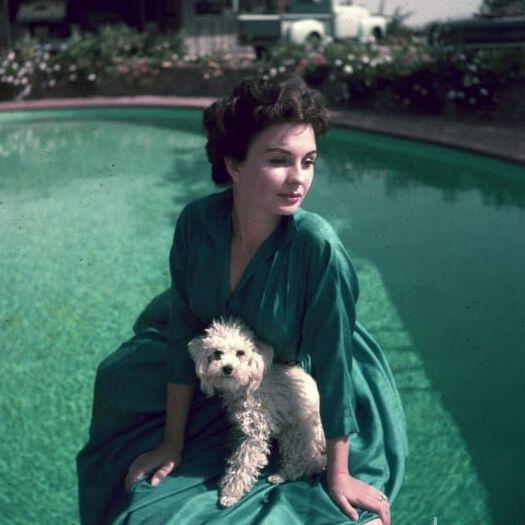
Jean Simmons, whose ethereal screen presence and starring roles with Hollywood's top actors made her a mid-century film icon, has died at age 80.
The actress, who sang with Marlon Brando in "Guys and Dolls;" costarred with Gregory Peck, Paul Newman and Kirk Douglas; and played Ophelia to Laurence Olivier's Hamlet, died Friday at her home in Santa Monica, her agent Judy Page told the Los Angeles Times. She had lung cancer.
Already a stunning beauty at 14, Simmons made her movie debut in the 1944 British production "Give Us the Moon."
Several minor films followed before British director David Lean gave the London-born actress her breakthrough role of Estella, companion to the reclusive Miss Havisham in 1946's "Great Expectations." That was followed by the exotic "Black Narcissus," and then Olivier's Oscar-winning "Hamlet" in 1948, for which Simmons was nominated as best supporting actress.
She would be nominated for another Oscar, for best actress for 1969's "The Happy Ending," before moving largely to television roles in the 1970s, '80s and '90s.
She won an Emmy Award for her role in the 1980s miniseries "The Thorn Birds."
Her other notable films included "Elmer Gantry" (with Burt Lancaster), "Until They Sail" (with Newman), "The Big Country" (Peck), "Spartacus," (Douglas), "This Earth Is Mine" (Rock Hudson), "All the Way Home" (Robert Preston), "Mister Buddwing" (James Garner) and "Rough Night in Jericho" (Dean Martin).
Simmons had left Britain for Hollywood in 1950, accompanied by her future husband Stewart Granger. There, they were befriended by reclusive tycoon Howard Hughes, who flew them to Tucson, Ariz., for a surprise wedding.
"When I returned from the honeymoon," Simmons told a reporter in 1964, "I learned that Hughes owned me — he had bought me from (British producer) J. Arthur Rank like a piece of meat."
What followed was a string of films that she would later dismiss as terrible, although she took some solace in the fact Hughes, legendary in those days as a womanizer, never bothered her.
"I was married to Jimmy (Granger's real name was James Stewart), so Hughes remained at a distance," she recalled. "But those movies! So terrible they aren't even on videocassettes."
Among the titles: "Angel Face," "Affair with a Stranger" and "She Couldn't Say No."
Simmons finally ended up suing Hughes for the right to make more prestigious films at other studios, and the result was "Young Bess" (as young Queen Elizabeth I), "The Robe" (the first movie filmed in CinemaScope), "The Actress," "The Egyptian" and "Desiree."
In the latter film, in 1954, she played the title role opposite Brando's Napoleon.
The pair teamed again in 1955 for "Guys and Dolls," the Samuel Goldwyn-produced musical in which Simmons is Sarah Brown, a Salvation Army-style reformer conned into a weekend fling in Havana by gambler Sky Masterson.
She loved the rehearsals for that film, Simmons recalled in 1988, "especially the dancing routines with Marlon trying not to step on me and choreographer Michael Kidd looking very worried."
"I got to sing," she added, "because Sam Goldwyn said, `You might as well wreck it with your own voice than somebody else's.'"
By the 1970s, her career as a lead film actress had ended, but Simmons continued to work regularly on stage and in television.
In the 1980s and '90s she appeared on such television shows as "Murder, She Wrote," "In the Heat of the Night" and "Xena: Warrior Princess." She also appeared in numerous TV movies and miniseries, including a 1991 version of "Great Expectations," in which she played Miss Havisham this time.
The careers of both Simmons and her husband Granger had flourished in the 1950s, he as a swashbuckler, she as the demure heroine. But long absences on film locations strained their relationship, and they divorced in 1960. They had a daughter, Tracy.
Shortly after her divorce, Simmons married Richard Brooks, who had directed her in "Elmer Gantry" and would again in "The Happy Ending." Their marriage, which produced a daughter, Kate. The couple separated in 1977 and later divorced.
Subscribe to:
Posts (Atom)